


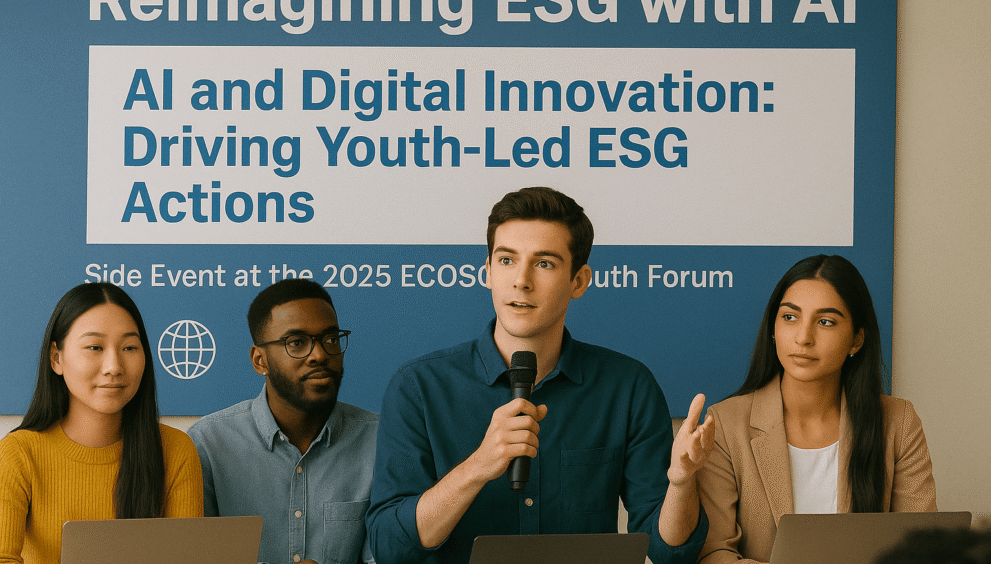
At a landmark UN ECOSOC Youth Forum side event, global youth leaders harness AI for
environmental equity, social inclusion, and transparent governance.
Reimagining ESG with AI: Global Youth Lead the Way
In a striking convergence of purpose, technology, and youth leadership, a side event at the 2025
ECOSOC Youth Forum in New York set the stage for a new global dialogue: how Artificial Intelligence
(AI) can be harnessed to drive Environmental, Social, and Governance (ESG) transformation. Titled
“AI and Digital Innovation: Driving Youth-Led ESG Actions”, the forum served as a vibrant hub for
young minds from across the world to present bold, tech-forward strategies for a more equitable,
sustainable future.
Jointly hosted by the United Nations University Institute in Macau, the Youth Environmental Friendly
Action Committee of the All-China Environment Federation, and Tianjin Foreign Studies University’s
Grouphorse ESG Industrial College, the event symbolized an important step in empowering youth
with tools of change.
Dr. Min Yang from UNU Macau opened with a powerful message: AI and ESG are not just
intersecting—they’re merging to form inclusive innovation platforms. Xing Tang, a key figure behind
China’s pioneering ESG college, added, “AI is not merely a tool, but a bridge turning digital capability
into sustainable action.”
Moderated by Lingxin Guo from Columbia University, the hybrid event spanned discussions on
climate action, social justice, and ethical innovation. Speakers included Columbia’s Zhou Yu, who
explored generative AI for public sustainability discourse, and Shangxuan Zhang of NYC Data Science
Academy, who warned that without aligning technical progress with ESG outcomes, innovation could
fall short of its transformative promise.
From Stanford to Singapore, each contributor painted a unique picture of AI’s potential. Dr. Jiaxin
Qing from UC Berkeley delved into AI’s role in healthcare and inclusion, while Stanford’s Zijiao Chen
spotlighted the urgent need for fairness and accessibility in AI applications. Others, like NUS
researcher Ziji Shi, took on the carbon cost of training AI models, advocating for “green AI” that
minimizes environmental impact.
The youth roundtable brought a deeply human element. Bohan Zhang, filmmaker and founder of
Morningside Studio, showcased AI-powered storytelling for cultural inclusion. Tianpu Zhang, a legal
expert from Becker Glynn LLP, framed AI as a domain requiring ethical international governance.
High school student Nakshatra Kothapalli shared how she empowers underserved youth through
coding and digital training.
Innovative voices like Wanting Yu and Xinyu Li reminded participants of the emotional and ethical
sides of digital tools. From AI-enabled art therapy to environmental responsibility in animation, their
projects proved that AI’s scope can stretch well beyond analytics into empathy and artistic ethics.
Rachael Xu, a UNESCO-endorsed youth accordionist, gave the stage a melodic close, showing how AI
is even reshaping inclusive music creation and protecting artist rights in a fast-evolving digital
economy.
Yujie Chen of Grouphorse ESG Industrial College closed the event with a rallying call: “As educators
and innovators, we must prepare youth to lead in an era of complexity and climate risk.” Xing Tang
echoed the sentiment, asserting that AI must become “a justice engine” to champion transparency,
equity, and inclusion.
As the forum wrapped, the message was clear: the youth are ready—not just to participate in the
ESG conversation, but to lead it. With AI as both compass and catalyst, they are building a future
where technology serves humanity, sustainability, and truth.
Key Highlights:
- Global Collaboration: Speakers from the US, China, Singapore, and more shared real-world applications of AI in ESG.
- Youth Leadership: Young innovators presented AI solutions ranging from mental health to emissions monitoring.
- Academic Integration: Institutions like Columbia, Stanford, Berkeley, and NUS led cutting-edge discussions.
- Ethical AI: Strong focus on fairness, inclusion, and environmental responsibility in AI development.
- Creative Technology: Artists and musicians showcased the intersection of creativity, justice ,and AI tools.
- Call to Action: A collective push for youth-led governance and digital justice in achieving the UN SDGs.

