New Delhi, June 24: M1xchange, an RBI licensed leading TReDS platform, has released its first ‘Working Capital Pulse Report’, highlighting the growing role of Tier II, Tier III and beyond markets in formal receivables financing.
The report reveals that 71% of MSMEs registered on the platform originate from these emerging business centres and contribute 67% of the platform’s total throughput, signaling the deepening reach of digital, formal financing beyond metropolitan markets.
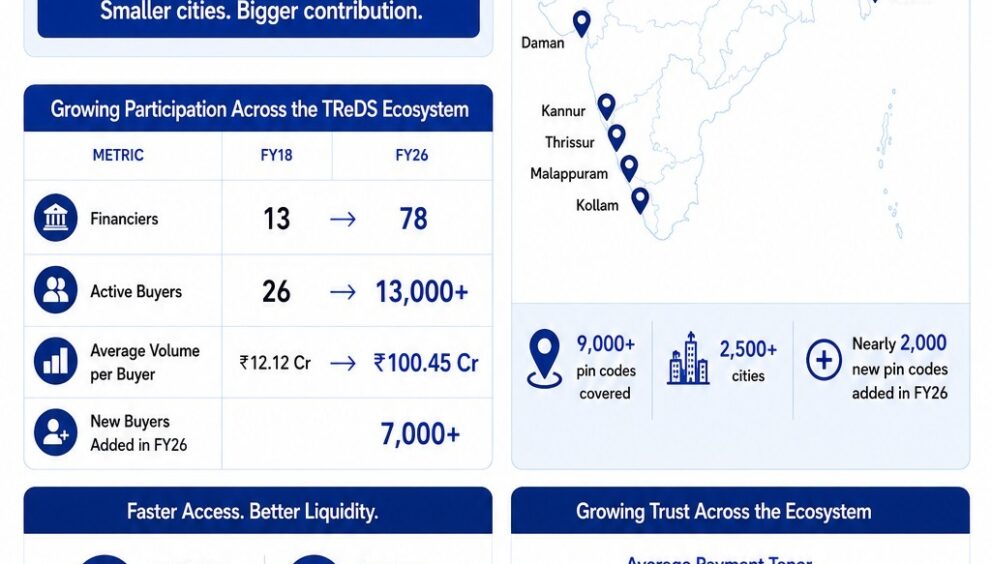
The report also highlights the expanding geographical reach of the TReDS ecosystem. Nearly 2,000 new pin codes were added in FY26, taking M1xchange’s reach to over 9,000 pin codes from more than 2500 cities. Far-of cities such as Kollam, Malappuram, Kannur, Thrissur, Jammu, Daman, Aizawl, Kargil and Baramulla are increasingly becoming part of the formal financing ecosystem, reflecting the rise of new business hubs across the country with access to working capital.
Today, the TReDS ecosystem facilitates invoice financing of over Rs 4 lakh crore annually. The report highlights that the rise in average tenors from 71 days to 87 days over the past few years reflects growing ecosystem maturity and deeper financier confidence rather than payment stress.
While MSMEs receive payments within 24 hours, buyers can optimize their working capital by utilizing full credit tenors. The increasing reliance on receivables financing is further evident from the fact that over 80% of MSMEs undertake repeat transactions, with 78% remaining active across multiple months.
Commenting on the findings, Sundeep Mohindru, Founder & Promoter, M1xchange, said the democratization of working capital finance is one of the most significant shifts we are witnessing in the MSME ecosystem today. Access to liquidity is no longer limited by geography, with businesses from Tier-II and Tier-III cities increasingly embracing digital financing solutions.
“The growing adoption of TReDS is helping address long-standing challenges around delayed payments while creating a more inclusive and efficient credit ecosystem. By combining technology, transparency, and institutional participation, digital receivables financing enabling businesses to access funds faster and focus on growth with greater confidence,” he said.
The ecosystem has seen increased participation from both corporate buyers and financiers. The number of financiers participating in invoice discounting has grown from 13 in FY18 to 78 currently, while active buyers have grown from just 26 in FY18 to over 13,000 in FY26. Notably, more than 7,000 buyers were added in FY26, supported by innovations such as S2S financing, which enables MSMEs to participate as buyers on the platform and leverage payable discounting solutions.
This has significantly expanded the reach of the ecosystem, bringing more MSMEs into formal financing channels and facilitating deeper-tier financing across supply chains. Average volume per buyer has increased from Rs 12.12 crore in FY18 to Rs 100.45 crore in FY26, indicating greater use of TReDS by corporates for managing payables. The average time taken to receive the first bid is close to four hours, while auto-bidding can generate bids in as little as 10 seconds, enabling efficient financing at scale with nearly 1.9 lakh invoices financed every month.
Infrastructure, electricals and electronics, steel and metals, auto and auto ancillaries, and agro are among the top sectors contributing to invoice financing activity. The report also points to seasonal patterns across sectors such as Agro and textiles that witness higher activity around harvest and festive cycles, while jewellery, trading and FMCG see increased activity during wedding and festive periods. Ceramics and tiles show higher activity after the monsoon and towards the end of the financial year.
The findings underline how digital receivables financing is evolving from an alternative funding mechanism into a critical pillar of India’s MSME ecosystem, helping address the longstanding challenge of delayed payments while expanding access to timely working capital across the country’s emerging economic centres.