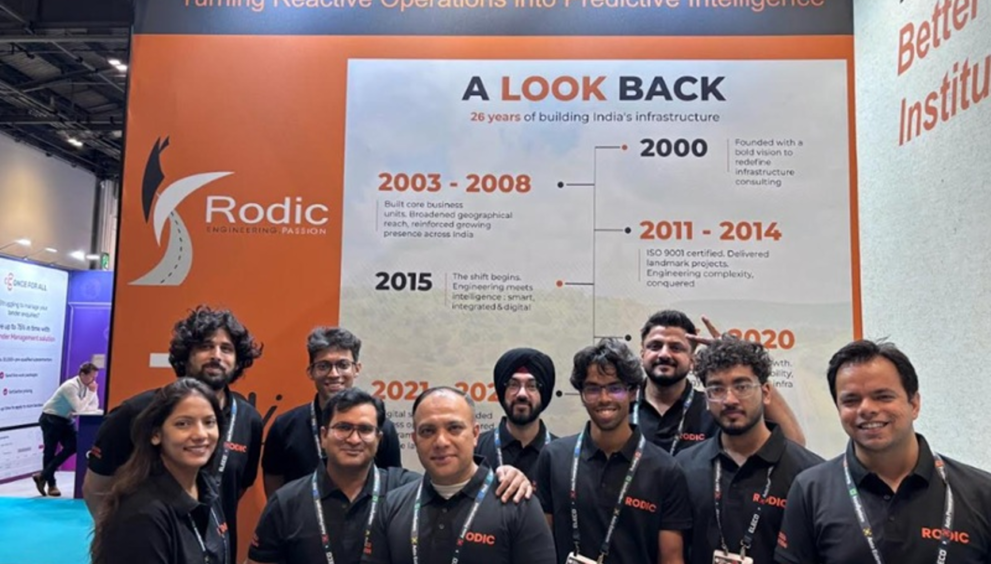
At Digital Construction Week London 2026, Rodic Consultants introduced an integrated sovereign AI platform designed to connect planning, execution, compliance, quality control and climate resilience into one secure intelligence layer for infrastructure delivery
Rodic Consultants has stepped onto the global stage with a bold proposition for the future of infrastructure delivery: artificial intelligence must move beyond isolated use cases and become the connective tissue of the entire project lifecycle. At Digital Construction Week London 2026, the Indian infrastructure advisory firm unveiled a sovereign AI ecosystem designed to help governments, infrastructure agencies and project owners tackle one of the sector’s most stubborn problems fragmented decision-making.
Built from Rodic’s experience across roads, railways, bridges, urban systems and public infrastructure, the platform has been conceived as a unified intelligence layer rather than a patchwork of standalone digital tools. Its purpose is clear: bring planning, field execution, compliance, quality assurance and climate resilience into one integrated operating environment, while ensuring that sensitive project data remains secure, auditable and under institutional control.
That positioning is especially significant at a time when infrastructure agencies around the world are under pressure to deliver faster, spend smarter and improve resilience, all while navigating rising regulatory complexity and climate risk. Rodic’s answer is a sovereign, air-gapped AI architecture that allows organisations to deploy advanced intelligence systems without surrendering control of critical operational data. In a sector where public assets, strategic infrastructure and long-term capital are involved, that promise of digital sovereignty may prove just as important as the AI capabilities themselves.
At the heart of the announcement is an integrated ecosystem of six AI systems operating on a common infrastructure intelligence stack. Rather than working in silos, each module is designed to feed into the next, creating a continuous flow of intelligence from the earliest stages of planning to long-term asset monitoring.
The Planning Agent is aimed at accelerating feasibility studies, planning exercises and detailed project report preparation by structuring infrastructure intelligence in a way that enables faster and more informed decisions at the project development stage. The Daily Progress Agent addresses one of the most persistent pain points in infrastructure execution manual reporting by helping eliminate repetitive data re-entry and enabling smoother visibility from field teams to senior management. The Visual Monitoring Agent extends oversight across project corridors and distributed assets through AI-led visual intelligence, giving owners a broader and more dynamic view of project conditions on the ground.
The governance layer of the platform is carried by the Risk & Compliance Agent, which provides audit-ready insights across contracts, compliance requirements, governance processes and risk registers. Alongside it, the Defect Management Agent focuses on identifying, tracking and resolving quality issues across infrastructure assets through AI-assisted workflows. Rounding out the ecosystem is AICIP, the AI Climate Intelligence Platform, which brings climate forecasting, resilience assessment and risk intelligence into infrastructure planning, reflecting the growing reality that climate adaptation can no longer be treated as a secondary consideration.
What makes the platform notable is not simply the presence of six AI applications, but the fact that Rodic is framing them as a single operating layer for infrastructure delivery. In practical terms, that means a project owner could move from planning intelligence to field performance tracking, compliance oversight, defect resolution and climate resilience analysis without switching between disconnected systems or losing continuity of data. For large infrastructure programmes, where information is often scattered across consultants, contractors, spreadsheets, dashboards and reporting formats, that kind of integration could represent a meaningful shift in how decisions are made.
Rodic’s leadership is positioning the platform as a response to a wider industry transition, one in which intelligence becomes as central to infrastructure as engineering design and construction execution. As Shri N.N. Sinha, Managing Director of Rodic Digital and Advisory, put it, infrastructure owners globally are searching for ways to improve productivity, strengthen governance, enhance resilience and make faster decisions in increasingly complex environments. He described the company’s AI ecosystem not as a loose collection of tools, but as a secure, unified intelligence framework built from decades of practical infrastructure experience.
That distinction matters. The infrastructure sector has not been short of digital promises in recent years. What it has often lacked is systems designed around the real operating complexity of public works, capital projects and long-life assets. Rodic is betting that the next phase of digital transformation will belong not to generic AI overlays, but to purpose-built platforms that understand the sector’s technical, regulatory and institutional realities.
Its showcase at Digital Construction Week London 2026 is therefore more than a product reveal. It is a statement of intent. Rodic is positioning itself not merely as an engineering and advisory company embracing AI, but as a builder of intelligent delivery ecosystems for the infrastructure age. If the model gains traction, it could signal a broader shift in how infrastructure is planned, governed and future-proofed across markets increasingly demanding security, speed and resilience in equal measure.