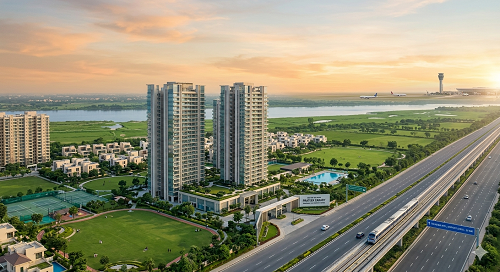
The Noida–Greater Noida Expressway continued attracting luxury homebuyers, investors, and developers as changing urban aspirations, infrastructure expansion, and demand for low density living reshaped the premium housing narrative across the National Capital Region.
Across the National Capital Region, the definition of luxury living has undergone a quiet but unmistakable transformation. For years, premium residential demand was closely associated with central locations, towering developments, and addresses linked to established prestige. Increasingly, however, affluent homebuyers have begun prioritising something very different: openness, liveability, connectivity, and a more balanced urban experience.
It is within this changing landscape that the Noida–Greater Noida Expressway emerged as one of NCR’s fastest evolving luxury real estate corridors.
What distinguished the stretch was not merely the volume of new projects entering the market, but the larger ecosystem taking shape around it. Compared to several densely populated urban pockets across NCR, the corridor increasingly came to be viewed as a more thoughtfully planned residential environment, where wider roads, lower congestion levels, integrated infrastructure, and expansive green spaces created a distinctly different living experience.
Industry observers noted that the appeal of the Expressway extended beyond aesthetics alone. The corridor benefitted from a growing sense of long term institutional confidence, supported by visible infrastructure execution and sustained development momentum over the years.
According to data cited by property consultancy Anarock, average residential prices in Noida rose from nearly ₹4,795 per square foot in 2020 to approximately ₹9,200 per square foot by the first quarter of 2025, reflecting almost 92 percent growth. Greater Noida reportedly outperformed even that trajectory with close to 98 percent appreciation during the same period, exceeding the broader NCR average growth rate of 81 percent.
The appreciation signalled more than speculative momentum. Analysts suggested it reflected increasing buyer confidence in the long term viability of the micro market, especially among high net worth individuals, non resident Indian investors, and globally exposed professionals seeking future ready residential environments.
A major catalyst behind this optimism was the growing infrastructure ecosystem surrounding the region. The inauguration of the Noida International Airport significantly strengthened the area’s strategic positioning within NCR’s evolving economic geography.
For many buyers, the airport represented not simply a transportation hub, but a long term indicator of future commercial relevance, business connectivity, and sustained urban expansion.
Similarly, metro network expansion across Noida and Greater Noida improved accessibility while reinforcing the perception that the corridor was becoming increasingly integrated with the larger NCR economy.
Yet infrastructure alone did not fully explain the luxury demand shift.
In sectors such as Sector 150 and Sector 128, developers increasingly focused on concepts centred around low density planning, landscaped environments, wellness amenities, sports infrastructure, walking trails, and larger open spaces between residential towers.
The emphasis gradually moved away from vertical density toward experiential living.
For many urban professionals and upwardly mobile families, that translated into a lifestyle offering reduced congestion, improved environmental quality, and a more measured pace of daily life without compromising connectivity to business districts and commercial centres.
The corridor also attracted buyers seeking stronger institutional management and secure gated ecosystems. NRI investors and affluent professionals increasingly preferred projects that combined hospitality inspired management, smart home technology, wellness oriented amenities, and branded development credibility.
One such project frequently referenced within the emerging luxury conversation was Prateek Canary, located in Sector 150. The development positioned itself as a low density super premium residential community focused on expansive layouts, green surroundings, and elevated living experiences.
Its emergence reflected a broader trend where developers were no longer selling merely square footage or skyline views, but an entire lifestyle narrative built around privacy, wellness, openness, and long term liveability.
According to market observers, established developers deepening investments along the Expressway also signalled growing confidence in the corridor’s future trajectory. In real estate markets, institutional commitment from reputed developers often serves as an indirect indicator of expected long term demand sustainability.
The transformation unfolding across the Noida–Greater Noida Expressway appeared to mirror larger shifts in urban aspiration across India’s metropolitan regions.
Luxury, increasingly, was no longer defined solely by centrality or exclusivity. Instead, buyers were placing greater value on environmental quality, infrastructure reliability, spatial comfort, integrated community living, and long term quality of life.
In that sense, the rise of the Expressway reflected more than a successful real estate cycle. It illustrated a changing philosophy of urban living itself, where future residents sought not just premium homes, but cities and communities designed around sustainability, balance, and enduring liveability.