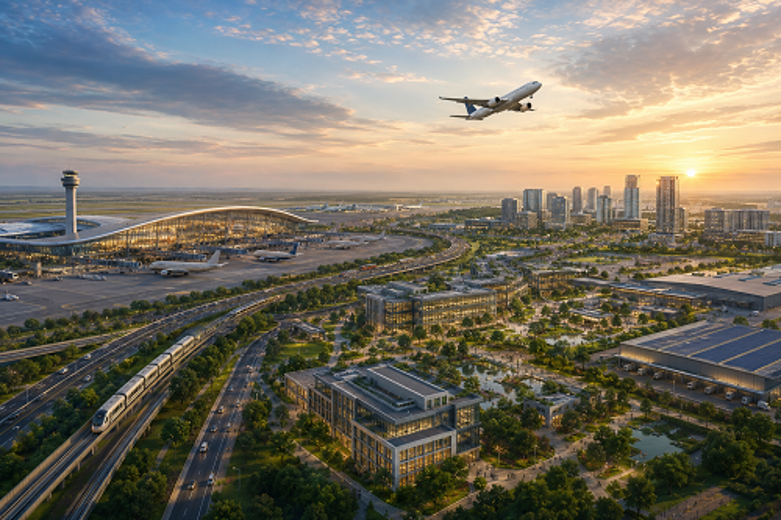
Noida International Airport may be the headline project, but the bigger transformation unfolding around Jewar is economic. From industrial parks and logistics hubs to premium housing and Grade A offices, the Yamuna Expressway corridor is emerging as a multi-sector growth engine for NCR
When a major airport is announced, the first wave of excitement almost always circles around flights, connectivity and rising property values. But airports, by themselves, do not create economic powerhouses. The world’s most successful airport-led regions became what they are because aviation infrastructure was followed by something larger: industries, logistics, business districts, jobs, housing and urban ecosystems that could sustain growth long after the first aircraft landed.
That is the larger story now beginning to take shape around Jewar.
The upcoming Noida International Airport is steadily moving beyond its identity as a transport project and emerging as the anchor of a much wider economic corridor across Noida, Greater Noida and the Yamuna Expressway belt. What is unfolding is not simply an airport story or even a real estate story. It is the early formation of a new growth geography for the National Capital Region, one where connectivity is acting as the trigger for industrial expansion, corporate investment, residential development and commercial activity on a much broader scale.
This is the pattern that transformed places such as Dubai, Singapore and Istanbul. Their airports did not become engines of growth in isolation. They became catalysts for trade, warehousing, manufacturing, tourism, finance and global business. The same logic is increasingly visible in Jewar. The airport is important, certainly, but what matters more is the ecosystem now building around it.
Industrial parks, logistics hubs, manufacturing clusters, data centres and Global Capability Centres are beginning to reshape the character of the region. What was once seen as a peripheral stretch on the edge of NCR is gradually being reimagined as an economic destination in its own right. The change is visible not only in land values or project launches, but in the kinds of businesses choosing to establish themselves here and the scale of infrastructure being planned to support them.
The Noida-Yamuna belt today sits at the intersection of several growth drivers. Improved road networks, expanding metro connectivity and the airport have strengthened its accessibility. Policy support and industrial planning have widened its economic appeal. At the same time, the region is attracting businesses that increasingly view infrastructure connectivity as a strategic advantage rather than a convenience. Manufacturing units, warehousing facilities and logistics operations are expanding across the corridor, setting off a chain reaction that naturally feeds residential demand, social infrastructure and commercial development.
That interplay is exactly what gives the region its long-term potential. Growth here is no longer being pinned to one sector alone. Manufacturing supports employment. Employment drives housing demand. Housing encourages retail, hospitality and urban services. Better infrastructure attracts more businesses, which in turn strengthens the region’s case for further investment. It is this self-reinforcing cycle, rather than the airport alone, that is turning Jewar into one of NCR’s most closely watched development stories.
The numbers already reflect the market’s growing confidence. According to SquareYards’ Runway to Realty: How Noida International Airport is Reshaping Realty report, apartment prices in the region have nearly tripled over the past five years, while plot values have risen by an average of 1.5 times. Some micro-markets have seen appreciation of up to five times. Yet increasingly, developers and market observers are treating these gains not as the main event, but as the by-product of a much deeper economic shift.
Manoj Gaur, CMD of Gaurs Group, captures this distinction well. “Airports alone don’t build cities; it is the ecosystem they unlock that does,” he says. For him, the airport has provided the initial momentum, but the real scale will come from the industrial parks, institutional developments and manufacturing clusters that are beginning to gather around it. He points to projects such as the proposed Leather Manufacturing Park, Toy Park and Electronic City, alongside investments by companies including Microsoft, Tech Mahindra, Patanjali and Escorts, as evidence that the region’s growth story is broadening rapidly. In his view, these developments are reshaping buyer sentiment across the Yamuna Expressway, driving demand for larger homes, integrated communities and premium developments.
That shift in buyer behaviour is becoming increasingly visible. The region is no longer being viewed only through the lens of affordability or speculative land investment. Instead, improved connectivity, emerging employment opportunities and stronger urban infrastructure are beginning to attract a more aspirational homebuyer one who is looking for integrated lifestyle environments and long-term value rather than just entry-level access to NCR real estate.
Yukti Nagpal, Director at Gulshan Group, notes that the Noida Expressway and Yamuna corridor have witnessed a visible change in buyer aspirations in recent years, especially among affluent homebuyers seeking better connectivity and more complete living environments. She argues that the airport is helping reposition the belt from a residential extension into a self-sustained urban destination with deeper investment potential.
Commercial real estate is expected to be another major beneficiary. As the economic ecosystem expands, demand for Grade A office spaces, mixed-use projects, retail destinations and hospitality assets is likely to rise in parallel. This is particularly relevant if the airport-led region succeeds in attracting more multinational corporations, GCCs and service-sector businesses looking for modern infrastructure and strategic access.
Sanchit Bhutani, Managing Director of Group 108, sees the airport as a trigger for precisely this kind of transformation. According to him, the real power of infrastructure lies in its ability to reshape economic activity by attracting enterprises, talent and institutional capital. Over time, he believes, the corridor could evolve into a significant commercial destination where office demand is supported by a strong foundation of industry, urban development and long-term infrastructure investment.
Manoj Kumar Garg, Chairman of NorthWind Estates, adds another dimension to the picture: the likely rise of hospitality, retail and entertainment infrastructure around the airport. With hotels, malls, multiplexes and aerocity-style commercial developments expected to take shape in the coming years, he believes the Yamuna Expressway region is steadily positioning itself as one of the most attractive destinations for businesses, investors and homebuyers alike.
Taken together, these signals point to a simple conclusion. The airport may be the headline, but it is no longer the whole story. Jewar’s real transformation will be defined by everything that follows the runway: the factories, the offices, the warehouses, the homes, the commercial districts and the jobs that build a functioning economic ecosystem around it.
In that sense, Noida International Airport is not the destination. It is the beginning. The real growth story of Jewar lies in what it is making possible and if the current momentum sustains, the region may well become one of the most consequential urban and economic expansions NCR has seen in decades.