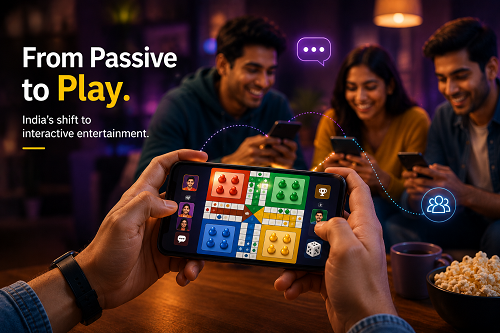
As millions of Indians move beyond passive screen time, interactive social gaming is emerging as one of the country’s fastest growing digital entertainment segments, powered by affordable smartphones, better connectivity and changing consumer behaviour
India’s digital entertainment landscape is undergoing a significant transformation. For years, streaming services, social media platforms and short form videos dominated consumer attention. Today, however, a growing number of users are seeking experiences that allow them to participate rather than simply watch.
This shift is giving rise to a new era of interactive entertainment, where competition, collaboration and real time engagement are becoming central to how people spend their leisure time. As a result, multiplayer and social gaming are rapidly moving into the mainstream.
According to Niko Partners, India’s gaming community is projected to exceed 700 million players by 2028, making the country one of the world’s fastest expanding gaming markets. The rapid adoption of affordable smartphones, inexpensive mobile data and wider 5G connectivity has further accelerated this momentum, opening digital gaming to users across both metropolitan centres and smaller cities.
Unlike traditional entertainment formats, interactive gaming places users at the centre of the experience. Instead of passively consuming content, players compete with friends, join communities, collaborate with others and influence outcomes in real time. This active participation has become particularly attractive to younger audiences, who increasingly value engagement and social interaction over conventional viewing.
The popularity of multiplayer games reflects broader changes in consumer behaviour. Entertainment today is expected to fit seamlessly into busy lifestyles while also creating opportunities for connection. Whether it is a quick game during a commute, an evening session with friends or a family competition across different cities, social gaming has evolved into a shared digital experience rather than an individual pastime.
One of the strongest examples of this evolution is Ludo, a classic board game that has successfully transitioned into the digital era. Long associated with family gatherings and festive occasions, the game has found renewed popularity on smartphones by combining familiar gameplay with real time multiplayer features.
Modern digital versions have introduced faster formats, live matchmaking and strategy based gameplay while preserving the simplicity that made Ludo a household favourite. This blend of nostalgia and innovation has helped attract millions of first time gamers who can start playing without navigating complex rules or lengthy tutorials.
Behind this growth is India’s rapidly improving digital infrastructure. Faster internet speeds, lower latency, cloud technologies and expanding 5G networks are enhancing multiplayer experiences by reducing lag and enabling smoother gameplay. At the same time, artificial intelligence driven matchmaking and personalised recommendations are helping platforms create more engaging user experiences.
These technological improvements are also expanding gaming adoption across Tier II and Tier III cities, where better connectivity and affordable devices are bringing new users into India’s digital economy.
Gaming companies are responding by designing experiences that prioritise accessibility, shorter sessions and community engagement rather than relying solely on advanced graphics or complex mechanics.
Among the platforms reflecting this industry trend is Zupee, which has reimagined traditional games such as Ludo through strategy focused, skill based formats designed for mobile first users. By modernising familiar gameplay without losing its cultural appeal, platforms like Zupee illustrate how classic games can continue evolving to meet changing consumer expectations.
Industry observers believe India’s social gaming ecosystem is still in its early stages. As digital infrastructure strengthens and consumer preferences continue to shift toward interactive experiences, gaming is expected to play an increasingly important role within the country’s broader digital entertainment economy.
Rather than replacing traditional entertainment, interactive gaming is becoming an additional layer of engagement, combining technology, competition and social connection in ways that resonate with modern audiences.
For India’s rapidly growing digital population, the future of entertainment appears to be less about watching and more about participating.
For readers following developments in India’s technology, gaming and digital economy, this trend reflects a broader transformation in how consumers connect, communicate and spend their time online.
For More Information
- Zupee: https://www.zupee.com/