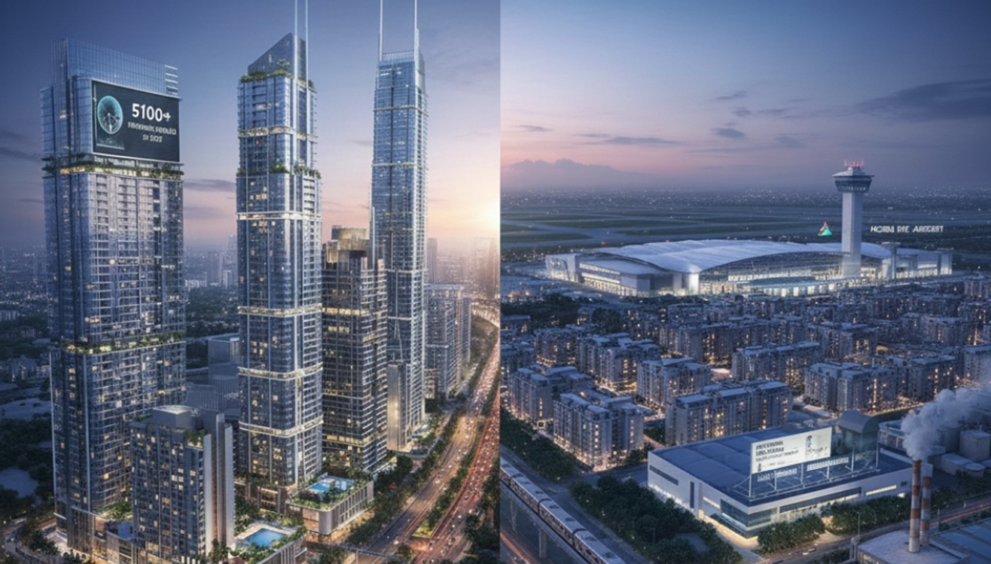
| Delhi NCR, India: After a period of volatility and uneven growth, 2025 emerged as a balanced year for Delhi-NCR’s real estate market. Rather than chasing short-term peaks, the region saw a measured and role-driven performance, with individual markets leveraging their inherent strengths. Gurugram and Noida–Greater Noida emerged as NCR’s strongest markets, each anchoring recovery in distinct ways. Data from the first half of 2025 indicates that Delhi-NCR recorded over 5,100 luxury home sales, with Gurugram accounting for the majority of premium transactions. This growth was largely driven by buyers’ preference for lifestyle-led homes, emphasizing space, amenities, and wellness. In contrast, Noida–Greater Noida delivered steady, scale-led growth, underpinned by progress on the Noida International Airport, expanded metro connectivity, and the maturation of industrial and IT corridors. Sahil Agrawal, CEO, Nimbus Group, said, “As we close 2025, one reality stands out clearly — the environment is no longer a peripheral concern; it is the new luxury. Health and air quality must now sit at the core of urban planning and real estate development. Buyers are increasingly prioritising clean air, green spaces and overall well-being over purely aesthetic features. Looking into 2026, lowering AQI levels will require collective accountability. Developers, governments, and citizens must work together to build cities that are not just aspirational, but genuinely healthy and future-ready.” Dr. Gautam Kanodia, Founder, KREEVA and Kanodia Group, added, “One of the clearest shifts in 2025 was how focused luxury buyers became about location within Gurugram. Attention narrowed to micro-markets such as SPR and New Gurugram, benefiting from infrastructure upgrades, better connectivity, and low-density luxury developments. Buyers and investors are prioritizing livability, access, future value, and community planning. Luxury housing in Gurugram is becoming increasingly corridor-led, and this trend will continue in the coming years.” Umang Jindal, CEO, Homeland Group, noted, “Gurugram benefits from a rare combination — strong luxury housing demand, global connectivity, and visible infrastructure progress. Buyer conversations are more mature; families and investors are evaluating livability, access, and long-term value rather than just price. Sustained wealth creation and employment growth remain key drivers of this demand.” Ashwani Kumar, Pyramid Infratech, added, “The real estate sector delivered strong and sustained performance in 2025, with developing corridors leading the growth graph. Luxury demand, particularly in Gurugram, was supported by evolving lifestyle preferences, higher disposable incomes, and spacious, well-planned homes. Improved infrastructure and connectivity made previously underserved areas attractive to buyers. Healthy demand, price appreciation, and new supply will continue to benefit NCR’s real estate market.” Prop Equity data also highlighted a year-on-year rise in residential sales value across leading Tier-II cities in Q1 2025, reflecting participation from both end-users and first-time investors. These trends position Tier-II markets not merely as spillover destinations, but as complementary growth centres supporting NCR’s real estate cycle. Sehaj Chawla, Managing Director, TREVOC Group, said, “India’s real estate sector in 2025 has been growth-oriented. Metro cities and NCR recorded massive demand for luxury residential spaces, and Tier-II cities gained prominence. With the RBI’s proactive stance, interest rates are expected to stay favorable, boosting the sector. Emerging cities, especially near NCR, will increasingly become prized assets for investors in 2026.” On the commercial side, retail and office real estate also showed strong validation for NCR’s growth. Harinder Singh Hora, Founder Chairman, Reach Group, stated, “Retail real estate expanded strongly in 2025, with Q3 emerging as a key inflection point. Leasing reached nearly 3.2 million sq. ft., driven by high-street and enclosed retail formats, experience-led destinations, and mixed-use developments integrating retail, office, and residential components. Retail performance is increasingly defined by location, design, visibility, and tenant curation rather than format alone.” Pankaj Jain, Founder and Chairman, SPJ Group, added, “Beyond established corridors, retail demand gained traction in micro-markets where residential catchments matured but organized retail supply remained limited. Old Gurugram zones, revitalized by infrastructure upgrades, showed stronger leasing traction and rental stability, driven by daily-need and lifestyle-led consumption.” Azad Ahmad Lone, President, Business Development and Operations, Biigtech, noted, “Noida–Greater Noida experienced one of its strongest commercial years. Office rentals rose 18% between 2019 and 2025, supported by infrastructure readiness, connectivity, and demand from IT, data centers, and manufacturing occupiers. Quality of leasing improved, with a focus on efficiency, compliance, and scalability. 2026 is expected to see steady, disciplined growth rather than short-term spikes.” |
As NCR moves forward, 2025 will be remembered as the year the region entered a mature and segmented phase of its real estate cycle. Gurugram, Noida, and Tier-II markets now operate with clearer roles and demand drivers, reducing volatility and deepening the market across the National Capital.