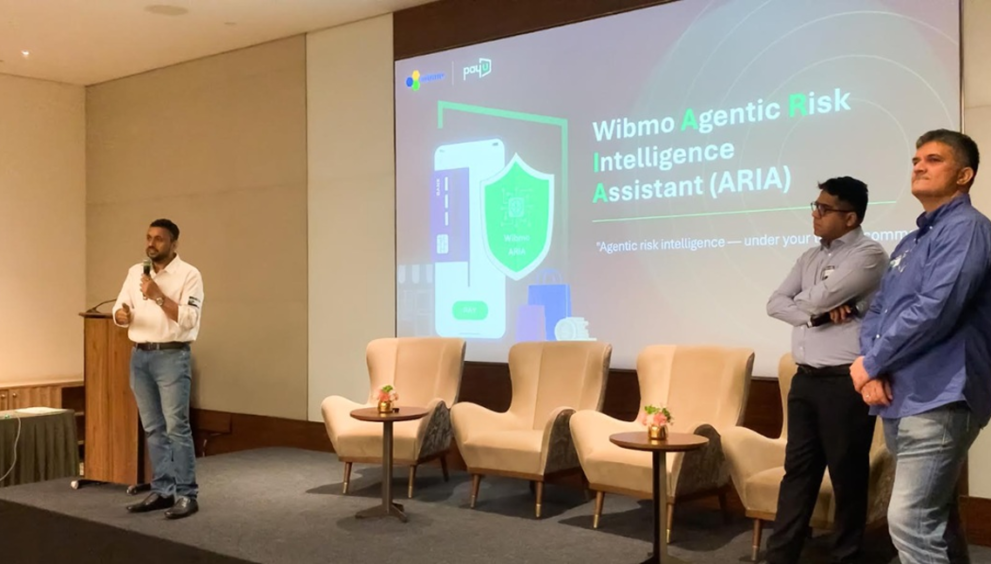
At a time when digital payments are scaling at breathtaking speed and fraud is becoming more layered, Wibmo has introduced ARIA, an AI-powered risk intelligence assistant designed to help banks and payment firms investigate faster, decide better, and strengthen governance without removing humans from the loop
As digital payments become the default mode of commerce, the risks surrounding them are evolving just as quickly. Fraud is no longer a matter of isolated suspicious transactions or one-off anomalies. It is increasingly sophisticated, multi-layered, and often designed to exploit the speed and complexity of modern financial systems. For banks, fintechs, payment service providers, and merchants, the challenge is no longer simply detecting threats, but doing so at scale, in real time, and with enough precision to protect customers without slowing the system down.
It is against this backdrop that Wibmo, a PayU company and a long-standing player in payment security, has unveiled Agentic Risk Intelligence Assistant (ARIA), an AI-powered platform built for financial crime operations. Introduced at Wibmo’s flagship event, Securing Digital Payments: Innovation, Intelligence & Trust, held at Mumbai’s Jio World Convention Centre, ARIA signals a significant shift in how risk teams could operate in the coming years.
At its core, ARIA is designed to support fraud, AML, KYC, and dispute management teams by combining AI-driven intelligence with human oversight. Rather than positioning artificial intelligence as a replacement for investigators and analysts, Wibmo is framing ARIA as an operational co-pilot, one that can absorb the heavy lifting of data gathering, signal analysis, and pattern recognition, while leaving final accountability and decision-making in human hands.
That distinction matters. In financial services, where regulatory expectations are high and errors can be costly, the idea of handing over critical risk decisions entirely to autonomous systems remains uncomfortable for many institutions. Wibmo’s answer is to build an intelligence layer that accelerates operations without dismantling governance.
According to the company, early modelling suggests ARIA can reduce investigation time by more than 70 percent by enabling agents to act in real time and handle repetitive analytical tasks that would otherwise consume hours of manual effort. The platform is also targeting recommendation accuracy close to 90 percent, a figure that, if delivered in real-world deployments, could significantly improve productivity and quality across risk operations teams.
The business case for such a platform is straightforward. Digital payments have expanded rapidly across India and other emerging markets, bringing with them a surge in transaction volumes, new user segments, more merchant categories, and more opportunities for bad actors to exploit weak points. Meanwhile, risk teams are often expected to do more with limited manpower, tighter turnaround times, and growing compliance obligations. Manual investigation models, however skilled the teams behind them may be, are under pressure. ARIA is built to address precisely that bottleneck.
The platform pulls together signals from transactions, customer and merchant histories, risk models, linked transaction behaviour, and historical fraud patterns. It then uses AI to aggregate that data, identify anomalies, and generate evidence-referenced recommendations. Instead of analysts manually piecing together multiple systems and reports, the platform aims to deliver a unified view of a case, along with contextual reasoning and suggested next steps.
Its role does not end at investigation support. Wibmo says ARIA also enables SOP-driven resolutions, supports communications with customers and merchants, helps reduce false alerts, and can proactively identify emerging anomalies before they become larger threats. In effect, it seeks to move risk operations away from a reactive model and toward a more continuous intelligence-driven workflow.
Shailesh Paul, CEO of Wibmo, underscored that balance between AI speed and human judgment while announcing the platform. “As fraud becomes more sophisticated and regulatory expectations continue to evolve, risk operations teams must manage growing complexity with limited resources. ARIA is designed to help institutions scale intelligently by combining the speed and analytical capabilities of AI with the judgment, oversight, and accountability of human expertise. While AI agents assist with data analysis and recommendations, every critical decision continues to remain firmly under human control.”
That final point is central to ARIA’s positioning. Wibmo has deliberately differentiated the platform from fully autonomous AI systems. ARIA is built with what the company calls a governance-first architecture, meaning recommendations continue to flow through existing approval systems and no autonomous production action is taken without oversight. Every recommendation is backed by transparent reasoning chains and audit trails, allowing institutions to trace how a conclusion was reached, what data informed it, and what action followed.
In an environment where explainability is becoming almost as important as accuracy, this design choice could prove crucial. Financial institutions are under increasing pressure not just to manage fraud and compliance effectively, but to show regulators, auditors, and internal stakeholders that their systems are fair, traceable, and accountable. A black-box AI model may be powerful, but in a high-stakes regulated setting, opacity can become a liability. ARIA appears to be Wibmo’s attempt to bridge that gap between AI capability and enterprise trust.
The platform’s architecture also reflects the fact that financial crime operations are no longer confined to one department. Fraud, anti-money laundering, know-your-customer checks, and disputes often intersect in complex ways, yet many institutions still manage them through fragmented tools and siloed workflows. By bringing these functions into a unified framework with specialised agents, Wibmo is betting that the future of risk management will depend as much on orchestration as on intelligence.
The launch event itself reinforced that view of the market. More than 50 senior leaders from banks, fintechs, payment networks, and technology firms gathered to discuss the future of digital payment security. Participants from PayU, NPCI Bharat Billpay, Visa, Mastercard, Flipkart, CSB Bank, Jio Payment Solutions, and Network International joined conversations around acquiring fraud risk management, authentication technologies, and risk-based decisioning. The breadth of those participants reflects a wider industry reality: payment security is no longer a niche operational issue, but a strategic business concern with implications across customer experience, compliance, and growth.
For Wibmo, ARIA is more than a new product launch. It is also a statement about where payment security is heading. The next chapter in fraud prevention is unlikely to be defined by more dashboards, more alerts, or more isolated tools. It will be shaped by systems that can connect signals, surface meaningful insights quickly, and still operate within the guardrails of enterprise governance.
That is the opportunity ARIA is aiming to capture. If it can deliver on its promise, not just in speed but in explainability, quality, and operational fit, it could become a meaningful addition to the way financial institutions manage fraud and financial crime in a world where digital payments keep growing, and so do the risks that come with them.