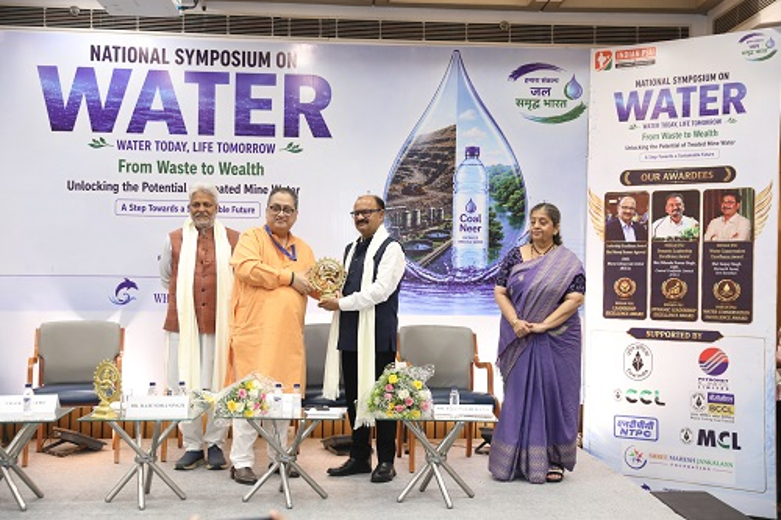
Environmentalists, policymakers, public sector leaders and water experts at the National Symposium on Water in New Delhi called for collective action, sustainable resource management and innovative solutions to strengthen India’s water security
India’s growing water challenge requires a response that extends well beyond government programmes and individual conservation efforts. It calls for sustained collaboration among policymakers, public sector organisations, communities, researchers and civil society. This was the central theme of the National Symposium on Water, organised at the India International Centre in New Delhi.
Organised by White Dolphin Media under the aegis of IndianPSU.com, the symposium brought together environmentalists, academicians, policymakers, public sector leaders, journalists and social activists to deliberate on water conservation, sustainable use of resources and the need for practical solutions to India’s evolving water security challenges.
The symposium placed particular emphasis on Coal Neer, From Waste to Wealth: Unlocking the Potential of Treated Mine Water, highlighting the potential of innovative water treatment technologies to convert an environmental challenge into a useful resource. The initiative, undertaken by Coal India Limited, focuses on treating mine water and making it available as safe drinking water for communities in and around coal mining areas.
Water Security as a Collective Responsibility
Renowned environmentalist and Ramon Magsaysay Awardee Dr. Rajendra Singh, popularly known as the Waterman of India, delivered the keynote address. He stressed that water conservation cannot remain the responsibility of governments alone and must become a collective responsibility involving citizens, communities and institutions.
Drawing from the experience of Tarun Bharat Sangh, which has worked with villages for nearly five decades to develop water conservation structures and revive local water sources, Dr. Singh highlighted the importance of community led approaches. He also spoke about the close relationship between water, women and rivers through the message, “Neer Naari Nadi = Narayani”, underscoring their importance to human civilisation and sustainable development.
Indira Khurana, Chairperson of the Indian Himalayan River Basins Council and Vice Chairperson of Tarun Bharat Sangh, highlighted the impact of water scarcity on communities, particularly women in rural areas. She called for more efficient water management, protection of natural water bodies and stronger policy interventions to build long term water security.
Innovation and Sustainable Resource Management
The discussion around Coal Neer reflected a broader need to rethink how India manages industrial water resources. Treating mine water for community use demonstrates how technology and responsible resource management can work together to address environmental concerns while supporting communities facing water scarcity.
The symposium brought together experts from diverse disciplines, including Prof. Rana Pratap Singh, Senior Professor at Babasaheb Bhimrao Ambedkar University, Farrukh R. Khan, former Regional Director at WaterAid, Dr. Avantika Singh of the University of Delhi and veteran journalist Utkarsh Sinha.
Discussions focused on integrated water management, climate resilience, sustainable use of natural resources and stronger community participation in conservation efforts.
Recognising Water Leadership
The symposium also recognised individuals and institutions contributing to water conservation and sustainability. Manoj Kumar Agarwal, CMD of Bharat Coking Coal Limited, received the INDIAN PSU Frontline Leadership Excellence Award for his leadership in water sustainability initiatives, particularly Coal Neer.
Nilendu Kumar Singh, CMD of Central Coalfields Limited, received the INDIAN PSU Dynamic Leadership Excellence Award for advancing sustainable water management practices across mining operations. Sanjay Singh of Parmarth Samaj Sevi Sansthan received the INDIAN PSU Water Conservation Excellence Award for his work in Bundelkhand, while Sanjay Agarwal, General Manager, BCCL, received the INDIANPSU Aqua Genetic Award for his contribution to developing the Coal Neer water treatment and purification plant.
Welcoming participants, Vivek Avasthi, CEO of White Dolphin Media and Editor in Chief of IndianPSU.com, said the symposium was conceived as more than a one day discussion and sought to build a wider movement around water conservation and sustainable resource management.
The symposium concluded with a collective call for sustained action. India’s water future will depend on the ability to bring together policy, technology, institutional leadership and community participation. The message from New Delhi was clear: securing water for the future requires not one solution, but a shared national commitment.