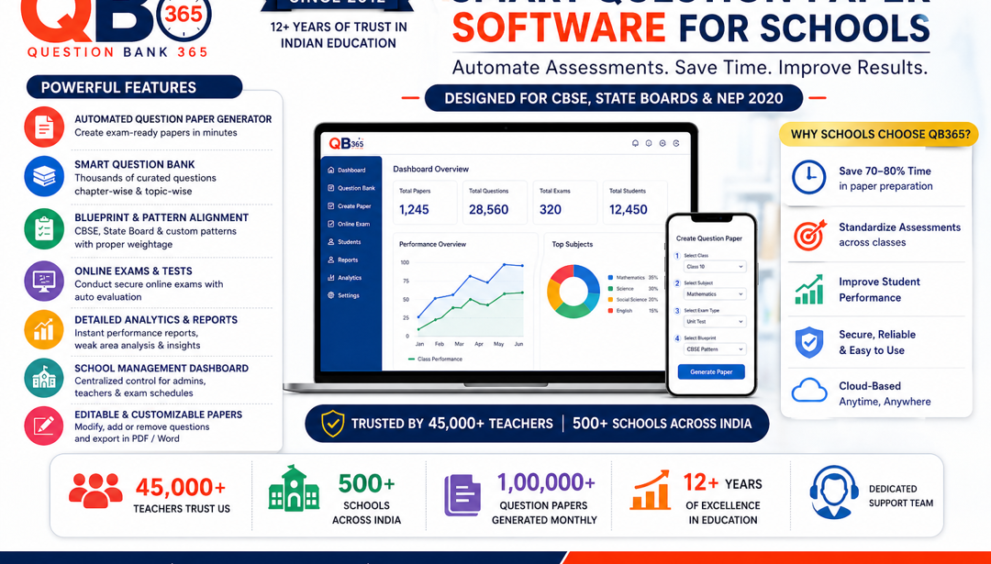
With growing pressure on educators to deliver faster, more standardised, and competency-based assessments, QB365 is positioning itself at the centre of India’s digital education transformation through automated question paper generation and analytics-driven school assessment systems
India’s education sector is undergoing a significant digital shift as schools increasingly adopt technology-driven systems to modernise classrooms, improve assessment quality, and reduce administrative pressure on educators. Among the areas witnessing rapid transformation is academic evaluation, where schools are moving away from traditional manual processes toward automated and data-driven assessment models.
Against this backdrop, QB365, an education technology platform developed by LINLAX INFOTECH PRIVATE LIMITED, has launched an advanced question paper generation and school assessment platform designed specifically for Indian schools, teachers, and academic institutions.
The platform aims to address one of the most persistent operational challenges in school education: the time-intensive process of preparing high-quality examinations aligned with CBSE and state board frameworks.
For decades, question paper preparation across Indian schools has largely remained a manual exercise. Teachers often spend long hours compiling questions, balancing syllabus weightage, maintaining blueprint alignment, and ensuring academic consistency across classes and subjects. In many institutions, the process also creates challenges around standardisation, repetition, and quality control.
QB365 seeks to simplify this workflow through automation, structured academic frameworks, and integrated analytics tools designed for modern classroom environments.
The platform’s core feature is its automated question paper generation system, which enables educators to create complete assessments within minutes using preloaded chapter-wise question banks and blueprint-based configurations. Schools can generate question papers aligned with CBSE guidelines, state board structures, and customised academic requirements.
In addition to automation, the platform includes a large repository of categorised academic questions arranged by difficulty level and learning objectives. The system supports multiple question formats, including MCQs, competency-based assessments, Higher Order Thinking Skills (HOTS) questions, and case-study-based evaluations increasingly emphasised under India’s evolving education policies.
The emergence of such platforms reflects broader shifts taking place within India’s education ecosystem following the implementation of the National Education Policy (NEP) 2020, which places greater emphasis on conceptual learning, competency development, and continuous assessment models rather than rote memorisation alone.
Industry observers note that schools today are under growing pressure to modernise academic systems while simultaneously managing increasing administrative workloads, hybrid learning environments, and evolving board examination patterns.
QB365’s platform also includes online examination modules, automated evaluation systems for objective assessments, and analytics dashboards designed to help schools monitor student performance at both individual and class levels.
These analytics tools allow educators to identify learning gaps, evaluate performance trends, and make more data-informed teaching decisions. For school administrators, the system offers centralised monitoring features covering examination schedules, teacher activity, academic reporting, and institutional standardisation.
According to the company, one of the platform’s primary goals is to reduce the operational burden placed on teachers, enabling them to focus more on instruction and student engagement rather than repetitive administrative tasks.
Educational technology analysts suggest that automation platforms focused on assessments may become increasingly important as Indian schools scale digital learning infrastructure across urban and semi-urban regions.
The demand for such systems has accelerated in recent years due to multiple factors, including increased digital adoption following the pandemic, growing expectations around academic accountability, and the rising use of analytics in education management.
QB365 stated that its software has been developed specifically around Indian educational requirements, supporting CBSE curricula, multiple state board systems, and school-specific customisation frameworks.
The company claims the platform is already being used by over 45,000 teachers and more than 500 schools across India, positioning it among the emerging players in India’s rapidly expanding EdTech assessment segment.
Beyond software deployment, QB365 is also expanding through a district-level franchise and partnership model aimed at increasing adoption among schools across different regions of the country. The initiative is intended to support local implementation, onboarding, and institutional training as schools transition toward digital academic systems.
Industry experts note that while India’s EdTech market has historically focused heavily on student learning applications and test preparation platforms, institutional infrastructure tools for schools remain a relatively underdeveloped but fast-growing segment.
As schools continue investing in digitisation, platforms that combine automation, analytics, curriculum alignment, and administrative efficiency are expected to play a larger role in shaping the future of academic operations.
For QB365, the expansion represents more than the launch of another school software product. It signals the growing evolution of India’s education sector toward integrated digital ecosystems where assessments, analytics, and academic management are increasingly interconnected.
In that changing landscape, automated assessment platforms are emerging not simply as convenience tools, but as foundational infrastructure supporting how schools teach, evaluate, and measure learning outcomes in the digital education era.