A new wave of electronics manufacturing will make India self-reliant in key components—from camera modules to circuit boards—while generating exports worth billions and creating over 5,000 skilled jobs.
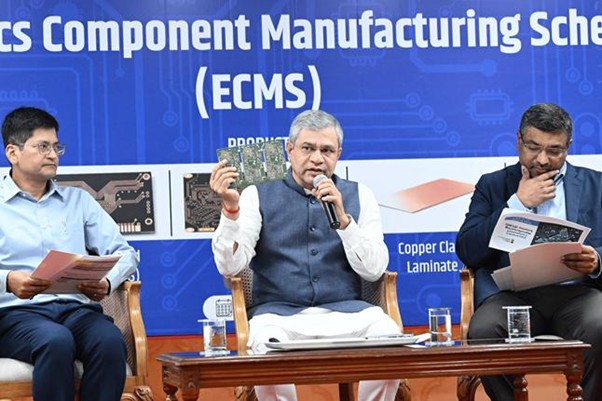
In a move that positions India firmly on the global electronics manufacturing map, the Ministry of Electronics and IT has approved the first batch of seven projects under the Electronics Components Manufacturing Scheme (ECMS), with a cumulative investment exceeding ₹5,500 crore. Announced by Union Minister Ashwini Vaishnaw, the projects mark a decisive step in India’s transformation from a manufacturer of finished products to a producer of core components, materials, and machinery that power the electronics industry.
These seven projects—spread across Tamil Nadu (5 units), Andhra Pradesh (1), and Madhya Pradesh (1)—are expected to generate ₹36,559 crore worth of production and create over 5,100 direct jobs, highlighting India’s commitment to fostering regional and high-tech industrial growth beyond metro cities.
Bridging the Demand–Supply Divide
The ECMS approval brings India closer to self-reliance in critical components. As Minister Vaishnaw explained, “20% of our domestic demand for PCBs and 15% of Camera Module sub-assemblies will now be met through domestic production.” Notably, 100% of India’s Copper Clad Laminate (CCL) demand will now be fulfilled locally, eliminating a significant import dependency. Beyond self-sufficiency, these units will also cater to global markets—60% of their total production will be exported, boosting India’s electronics exports footprint.
Strategic Components at the Core
The approved projects encompass a suite of high-impact components:
- High-Density Interconnect (HDI) and Multi-Layer PCBs – essential for the circuitry of smartphones, laptops, and industrial systems.
- Camera Modules – vital imaging units used in consumer electronics, drones, medical devices, and automotive systems.
- Copper Clad Laminates (CCL) – the foundational base for manufacturing multi-layer PCBs.
- Polypropylene Films – crucial materials for capacitors used in electronics, ICT, and telecom equipment.
The introduction of CCL and Polypropylene Film manufacturing marks a significant leap, as these are being produced domestically for the first time. The move not only strengthens India’s supply chains but also diversifies its industrial base for defence, renewable energy, and EV sectors.
Unprecedented Industry Response
The ECMS has attracted overwhelming interest—249 applications representing a potential ₹1.15 lakh crore investment and ₹10.34 lakh crore in production value, along with the creation of 1.42 lakh jobs. This is the largest-ever investment commitment in India’s electronics sector, reflecting investor confidence in India’s policy stability, manufacturing ecosystem, and market potential.
The selected projects serve as the first tranche in a series of approvals that will catalyze further investments in upstream and downstream industries, ensuring that India’s electronics manufacturing value chain—from materials to modules—is globally competitive and resilient.
A Foundation for the Future
The ECMS complements flagship initiatives such as the Production Linked Incentive (PLI) Scheme and the India Semiconductor Mission (ISM). Together, these programs create an integrated ecosystem for electronics—from chip design and fabrication to component and device assembly—enabling India to evolve from a consumer of technology to a global hub for innovation and production.
By reducing import dependence, generating skilled employment, and creating trusted supply chains, the ECMS reinforces India’s role as a trusted manufacturing partner in strategic sectors like defence, telecom, EVs, and renewable energy.
As Minister Vaishnaw aptly summarized, India is now “on its journey towards becoming a product nation—designing, manufacturing, and exporting world-class electronic equipment.”
Source: PIB