


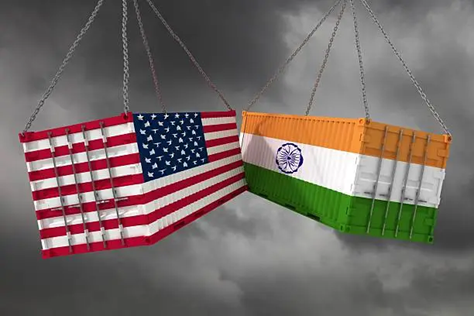
The recent announcement of additional U.S. tariffs on certain Indian exports has stirred debate among economists, businesses, and policymakers. While the move highlights trade frictions, it is crucial to view the development in context: India today is a more diversified and resilient economy than in the past. The real impact lies not just in immediate export numbers but in how Indian industries adapt, how domestic demand evolves, and how New Delhi strengthens trade ties beyond Washington.
U.S. Tariffs: The Present Scenario
America has chosen to raise tariffs on a specific set of Indian products, from textiles to certain engineering goods. While not broad-based across all exports, the move adds a layer of complexity to bilateral trade relations between two of the world’s largest democracies.
Based on statistics from India’s Ministry of Commerce, the U.S. is still India’s single largest market for exports, representing close to 17% of total outward shipments. Targeted tariff increases therefore affect exporters, especially in labor-intensive industries such as apparel, gems, and leather.
However, the government insists that India’s overall trade exposure is adequately diversified. With merchandise exports reaching over $437 billion in FY24 and services exports sustaining high momentum, policymakers contend that India’s export resilience is spread across several regions, lessening excessive dependence on a single partner.
Industries to Be Impacted
Textiles and Apparel:
The Indian textile sector, employing millions, faces direct exposure. Tariffs could make Indian garments relatively costlier in U.S. markets, eroding competitiveness against Bangladesh or Vietnam. Industry bodies like AEPC (Apparel Export Promotion Council) warn of margin pressures but also see scope for firms to move into higher-value segments.
Engineering Goods:
Engineering exports, a backbone of India’s industrial economy, are another area of concern. Tariff increases on specialized machinery or components may affect medium-sized exporters. Yet analysts note that India’s engineering base increasingly services Europe, the Middle East, and Africa, offering partial insulation from U.S. actions.
Gems and Jewellery:
India, the world’s largest diamond processing hub, ships significant volumes to the U.S. Higher tariffs could dent short-term sales, but with rising demand in Gulf countries and the domestic luxury segment, industry insiders believe long-term risks remain manageable.
Financial Market Response
Stock markets initially reacted with caution, with companies exposed to exports coming under pressure. Shares of specific textile and jewellery exporters declined, indicating concern among investors. However, larger indices such as the Nifty50 and Sensex remained robust, reflecting investor confidence in India’s diversified growth narrative.
Analysts note that India’s economy is becoming increasingly domestic-centric, with private consumption accounting for almost 60% of GDP. This acts as a buffer against external shocks, unlike economies heavily dependent on exports.
India’s Alternatives and Resilience
Though U.S. tariffs seem daunting, experts point out that the broader economic impact is likely limited. India’s trade approach has changed dramatically over the last decade:
- Diversification of Trade Partners: India has expanded export footprints in the UAE, EU, Australia, and select African nations. FTAs with the UAE and Australia have borne fruit, and negotiations with the EU and UK are at an advanced stage.
- Domestic Consumption Pillar: With an expanding middle class, domestic demand for cars, electronics, and lifestyle products provides a fallback. Segments such as cement, housing, FMCG, and digital services perform regardless of tariffs elsewhere.
- Government Stance: Ministry of Commerce officials repeatedly assert that fundamentals are strong. “Their tariff action cannot derail the export or growth story of India. Our priority is diversification and value addition,” an official recently said.
This indicates that, while exporters in some sectors might experience short-term discomfort, the macro effect on India’s $4-trillion economy is expected to be limited.
Expert Opinions
Neutral Economic View:
Dr. Ajit Ranade, economist, notes:
“While the U.S. market is important, the overall export basket of India is wide. These tariffs are more of an irritant than a fundamental game-changer. Domestic demand, coupled with growth in services exports like IT and consulting, keeps India relatively safe.”
Business Leader Perspective:
Sanjay Budhia, Chairman of CII’s National Committee on Exports, says:
“Textile and jewellery exporters may face some headwinds, but the global supply chain now looks to India as a stable and reliable partner. With strategic trade deals, India can redirect much of the potential loss.”
Financial Market Analyst View:
A note from Motilal Oswal Financial Services states:
“The stock market may react to headlines, but the real economic impact is limited. Investors are confident in India’s long-term growth, especially with government spending, infrastructure push, and resilient domestic demand.”
FAQs
Q1. How significant are U.S. tariffs for India’s economy?
A: The impact is sector-specific. Industries like textiles and jewellery feel pressure, but at a macro level, India’s large domestic economy and diversified exports mitigate risks.
Q2. Will India retaliate with counter-tariffs?
A: India typically pursues dialogue over retaliation, focusing on stable trade relations. Past disputes, such as on steel and aluminium, were resolved without prolonged tariff wars.
Q3. Are Indian exporters shifting to new markets?
A: Yes. FTAs with the UAE and Australia have boosted exports, while negotiations with the EU and UK could open more opportunities.
Q4. Does this affect India’s growth outlook?
A: Not materially. India’s GDP growth, projected at 6.5–7% for FY25 by multilateral agencies, is primarily driven by domestic consumption and investment.
Q5. Which sectors are most insulated?
A: Sectors such as IT services, pharmaceuticals, domestic retail, cement, and housing are largely unaffected by U.S. tariff moves.
Conclusion
The U.S. tariffs on certain Indian exports highlight the volatility of international trade. Nevertheless, India’s economic direction is robust, anchored in domestic consumption, trade diversification, and resilient sectors. Although exporters of textiles, gems, and engineering goods might experience adjustments, the broader economy is positioned to absorb the shock.
Over the coming months, Indian exporters’ ability to reposition globally, alongside diplomatic efforts, will be crucial. The tariffs are a surmountable challenge, not a knockout blow. India continues to navigate as a stable economy, balancing international opportunities with domestic resilience.

