Nearly 95% of India’s trade by volume and about 70% by value moves through maritime routes,
demonstrating the sector’s pivotal role in the nation’s economic strength and global competitiveness. From crude oil and industrial commodities to electronics and agriculture, India’s commercial lifelines run across the oceans. As the country strengthened its position as a manufacturing hub and emerging energy power, seamless maritime logistics continued to anchor growth and strategic influence.
The Maritime India Vision 2030 (MIV 2030), launched in 2021, served as a transformational roadmap for this progress. With more than 150 initiatives planned and investment estimates between 3–3.5 lakh crore, the vision aimed to modernize ports, expand shipping and coastal logistics, strengthen inland waterways, boost global trade linkages, and build a skilled maritime workforce. A recent support package of 69,725 crore for shipbuilding further accelerated this ambition, reflecting India’s determination to enhance its global maritime footprint.
India Maritime Week 2025 added fresh momentum to this transformation. Organized in Mumbai from 27th to 31st October 2025, it became one of the most significant global maritime forums. With participation anticipated from more than 100 countries and over 100,000 delegates, the event focused on technology, investment, and infrastructure for the next phase of maritime expansion.
India’s port capacity nearly doubled between 2014 and 2025, rising from 1,400 MMTPA to 2,762 MMTPA. Cargo handling also surged from 972 MMT to 1,594 MMT. Major ports alone handled around 855 million tonnes of cargo in FY 2024–25, up from 819 million tonnes the previous fiscal year. Operational efficiency milestones were equally impressive, with vessel turnaround time slashed from 93 hours to 48 hours. Financial performance strengthened as annual surplus increased from 1,026 crore to 9,352 crore, while operating ratios improved from 73% to 43%, enhancing sustainability.
The shipping sector experienced parallel advancement. The number of Indian-flagged vessels grew from 1,205 to 1,549, and gross tonnage expanded from 10 MGT to 13.52 MGT. Coastal shipping nearly doubled, reaching 165 MMT from 87 MMT, offering low-cost and eco-friendly transport alternatives aligned with India’s climate goals.
India’s inland waterways witnessed one of the most remarkable transformations. Cargo movement increased from just 18 MMT in 2014 to 146 MMT in 2025—an exceptional rise of over 710%. The number of operational waterways expanded from 3 to 29. Infrastructure projects such as the World Bank–assisted Haldia Multi-Modal Terminal reflected this growth, enabling multimodal logistics and greater regional connectivity. Ferry and Ro-Pax services carried more than 7.5 crore passengers in 2024–25, highlighting increasing public preference for water-based travel.
India’s seafaring workforce grew from 1.25 lakh to more than 3 lakh in a decade, now accounting for 12% of the global seafaring talent pool—making India one of the top suppliers of trained maritime professionals in the world.
Financing mechanisms evolved to support this vast scale of development. A 25,000 crore
Maritime Development Fund ensured long-term capital access for port and ship capacity expansion.
The Shipbuilding Financial Assistance Scheme (24,736 crore) and Shipbuilding Development Scheme (19,989 crore) encouraged competitiveness, innovation, yard expansion, and greenfield investments. Northeast India also witnessed over 1,000 crore worth of waterway infrastructure upgrades. Tourism-focused initiatives, including two luxury cruise ships being built for operations on the Brahmaputra under the Cruise Bharat Mission, positioned river tourism as a high-potential economic avenue.
The Sagarmala Programme remained central to both MIV 2030 and the longer-term Maritime Amrit Kaal Vision 2047. Under Sagarmala, 840 projects worth 5.8 lakh crore were under implementation by 2035. Of these, 272 projects valued at 1.41 lakh crore were completed, while 217 worth 1.65 lakh crore were progressing swiftly. These large-scale investments helped reduce logistics costs, promote coastal economic zones, and create maritime-linked employment across the country.
A major milestone was achieved during the “Samudra Se Samriddhi” event in September 2025, where 27 MoUs worth over 66,000 crore were signed, unlocking around 1.5 lakh employment opportunities. These agreements ranged from greenfield ports and shipbuilding to sustainable shipping and maritime heritage. The Bahuda Greenfield Port in Odisha (150 MTPA capacity) and Water Metro Project in Patna using electric ferries exemplified the shift toward efficiency and environmental responsibility.
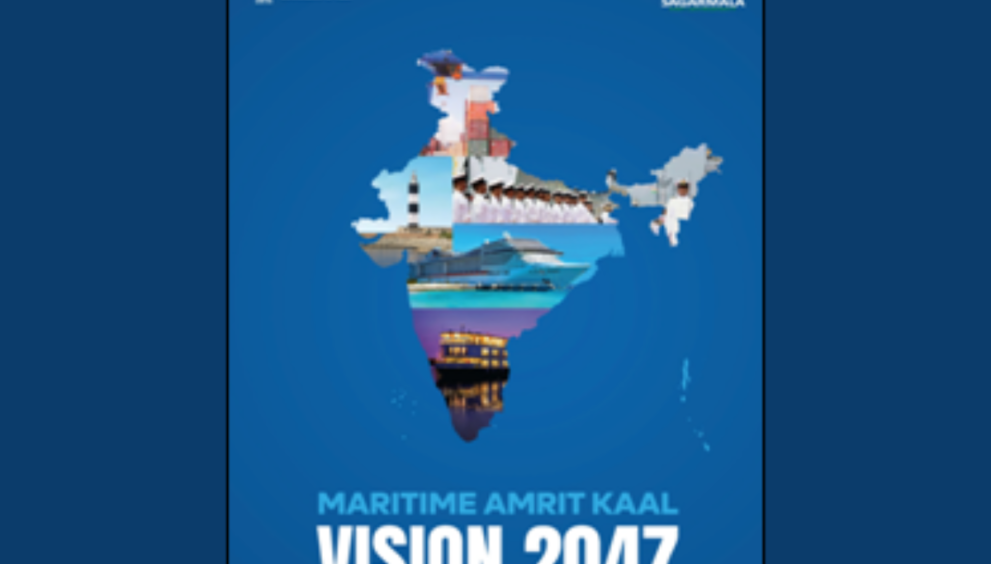
Looking ahead, Maritime Amrit Kaal Vision 2047 provided a long-term strategy to position India among the world’s top maritime nations by its 100th year of independence. With close to 80 lakh crore planned for ports, inland waterways, shipbuilding, digitalization, and green shipping infrastructure, the plan emphasized environmental stewardship, clean energy transitions, and resilient supply chains.
From enhancing global trade linkages and expanding port-led development to creating jobs and pioneering green maritime corridors, India’s journey from Vision 2030 to Amrit Kaal 2047 is shaping a future defined by economic strength, sustainability, and global leadership. With unwavering commitment and transformative action, India continues to turn its maritime vision into boundless opportunities for the nation and the world.