


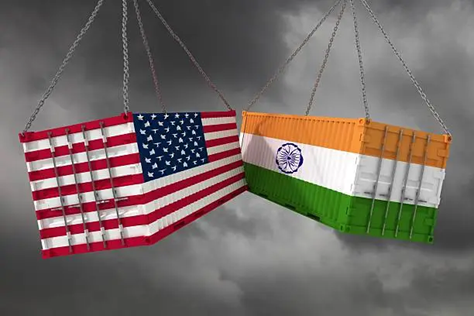
India’s exports to the United States have fallen 37.5% between May and September 2025, triggering alarm across key sectors and urgent calls for government intervention. According to an analysis by the trade think tank Global Trade Research Initiative (GTRI), this drop followed steep tariff hikes imposed by the Donald Trump administration – from 10% in April to 25% in early August, and to 50% by late August.
Exports to America, India’s largest export market, fell from US$8.8 billion in May to about US$5.5 billion in September, marking one of the sharpest short-term declines in recent years.
Tariff Escalation and Immediate Fallout:
The tariff escalation timeline is stark: The United States initially imposed a 10% “reciprocal” tariff in April, increased it to 25% around early August, and then added an additional 25% as a “penalty” linked to India’s oil procurements from Russia, bringing the total to 50%.
Goods that were earlier free of tariffs – nearly a third of shipments to the US – suffered the most drastic decline, collapsing 47%, from US$3.4 billion in May to US$1.8 billion in September.
Sector-by-Sector Breakdown: Who’s Hurting the Most?
According to GTRI’s data:
- Smartphones: Exports fell 58% — from US$2.29 billion in May to US$884.6 million in September. This is a sharp reversal from the 197% year-on-year surge during the same period last year.
- Pharmaceuticals: Declined 15.7% — from US$745.6 million to US$628.3 million.
- Industrial metals & auto parts: These saw a comparatively milder 16.7% slump — with aluminium down 37%, copper 25%, auto components 12%, and iron & steel 8%. GTRI attributed much of this dip to broader US industrial weakness rather than India’s loss of competitiveness.
- Labour-intensive sectors, such as textiles, gems and jewellery, chemicals, agri-foods, and machinery, account for nearly 60% of India’s US exports and contracted 33% in aggregate from US$4.8 billion to US$3.2 billion. Of this, gems and jewellery plunged nearly 59.5% — from US$500.2 million to US$202.8 million, with manufacturing hubs like Surat and Mumbai being hit badly.
- Solar panels/renewables: Exports tumbled 60.8% — from US$202.6 million in May to US$79.4 million in September — a major blow to India’s renewable energy export ambitions. GTRI flagged that competing countries like China and Vietnam face lower tariffs of 30% and 20%, respectively, on these goods in the US, denting India’s competitiveness.
Why the Sharp Fall? Root Causes & Vulnerabilities:
The GTRI report underlines two core issues:
- Tariff shock: The sudden 50% duty structure made many Indian goods unviable in the US market and eroded export margins, forcing cancellations or redirections.
- Structural weaknesses: The data highlight several underlying weaknesses in India’s export ecosystem — high dependence on a few key markets, a high share of labour-intensive goods with low value addition, limited diversification of destination markets, and vulnerability to policy changes overseas.
What’s more, India’s competitive edge is slipping: As India is hit harder than rivals, orders in categories such as gems & jewellery and textiles are increasingly shifting to Vietnam, Thailand, and Mexico.
Implications for India’s Trade Strategy:
MSME exporters from labour-intensive sectors are facing significant challenges. They are demanding government relief through faster duty remission, interest equalisation support, and emergency credit lines.
The broader economic impact is alarming — some analysts estimate this trade disruption could slice as much as 1 percentage point off India’s GDP growth for the fiscal year.
Competitiveness slide: India’s high tariff burden of 50% relative to peer exporters is undermining its market position. GTRI warns: “Without swift policy action, India risks ceding long-term ground to Vietnam, Mexico and China, even in sectors where it previously held a strong foothold.”
Currency & inflation pressure: The rupee weakened to record lows — approximately ₹88.3/US$, amid export uncertainty and capital outflows, adding cost pressure on industry.
What India Must Do: Policy Responses & Strategic Shifts
GTRI and industry bodies recommend:
- Diversifying export markets to Europe, Latin America, and Africa to reduce dependence on the US.
- Investing in technology, branding, and global supply-chain integration to upgrade value addition in labour-intensive exports.
- Providing quick relief measures, including interest support for MSMEs, faster duty drawbacks, and a calibrated currency policy to aid exporters.
- Engaging diplomatically to renegotiate trade terms with the US, seek tariff relief or phased duties, and press trade-defence instruments.
- Making Indian goods more competitive by reducing costs, upgrading quality standards, and leveraging strengths where tariffs are less punitive, such as in generic pharma and electronics.
Conclusion:
The 37.5% collapse in Indian exports to the US between May and September 2025 is more than a blip; it’s a warning signal. One of India’s largest trading relationships has just taken a sudden hit, with ripple effects across manufacturing clusters, export supply chains, and the wider economy. The data point not just to tariff-driven decline but to structural vulnerabilities an over-reliance on one market, large exposure to labour-intensive, low-value goods, and limited diversification. India’s export engines require urgent rebooting through market diversification, upskilling, higher value addition, and strong policy support. Failure to respond swiftly could make India lose not just the US market, but its place in global value chains that will define trade over the next decade.

