Artificial intelligence (AI) is increasingly moving beyond productivity, automation and customer experience to become a strategic tool for corporate sustainability. For businesses navigating decarbonisation, climate risk, ESG disclosure and resource efficiency, AI offers the possibility of turning vast amounts of fragmented data into actionable intelligence.
That opportunity, however, comes with an important qualification. AI itself has an environmental footprint, and poorly governed systems can amplify inaccurate data or even accelerate greenwashing.
These questions were at the heart of “AI and Sustainability: From Strategy to Scalable Impact,” a full day leadership programme organised by the International Institute of Corporate Sustainability and Responsibility (IICSR). The programme brought together leaders from Oracle, JSW, EY, Deloitte, GovEVA, Updapt ESG Tech and academia to examine how AI can improve sustainability performance while creating measurable business value.
Harsha Saxena, Founder and CEO of IICSR Group, framed the challenge succinctly: “AI’s intelligence carries a climate cost. Its true value will depend not only on what it can achieve, but on how responsibly we manage its energy, water and carbon footprint.”
From ESG Reporting to ESG Intelligence
One of the programme’s central themes was the shift from conventional ESG reporting towards what IICSR describes as real time ESG intelligence.
Traditional sustainability reporting is largely retrospective. Companies collect information, analyse performance and publish reports after the relevant period has ended. AI enabled systems, by contrast, can continuously process operational and environmental data, identify inefficiencies, forecast risks and help management respond more quickly.
Saxena argued that sustainability can no longer remain a periodic compliance exercise.
“Sustainability can no longer remain limited to annual disclosures, isolated pilot projects or distant Net Zero commitments. AI allows organisations to analyse thousands of data points, identify climate and operational risks earlier, optimise resources in real time and connect sustainability performance directly with financial decision making. The next competitive advantage will belong to companies that deploy AI responsibly, measure its impact and act on the intelligence it generates,” he said.
Applications explored during the programme included carbon accounting, Scope 3 emissions tracking, climate risk modelling, energy optimisation, supply chain monitoring, circular economy planning and automated ESG reporting.
The Business Case for Sustainable AI
The programme also examined the financial potential of combining AI with sustainability initiatives. According to the IICSR framework presented at the event, enterprise level programmes could potentially unlock $2 million to $10 million in annual value, depending on organisational scale, operational complexity, data quality and implementation maturity.
Potential benefits included 10% to 25% energy optimisation, representing estimated annual savings of $500,000 to $1.25 million. Operational efficiency improvements of 15% to 30% could potentially generate $1 million to $3 million in annual savings.
The framework also identified potential ESG reporting cost reductions of 30% to 50%, equivalent to approximately $100,000 to $500,000 annually. Revenue growth of 5% to 10% could potentially create an additional $2.5 million to $5 million, while predictive monitoring and climate risk intelligence could generate risk avoidance value ranging from $700,000 to $6 million annually.
The figures reinforce a broader shift in corporate thinking. Sustainability is increasingly being viewed not simply as a compliance cost, but as an opportunity to improve efficiency, protect revenue, strengthen resilience and manage risk.
Twelve Voices Across Technology and Sustainability
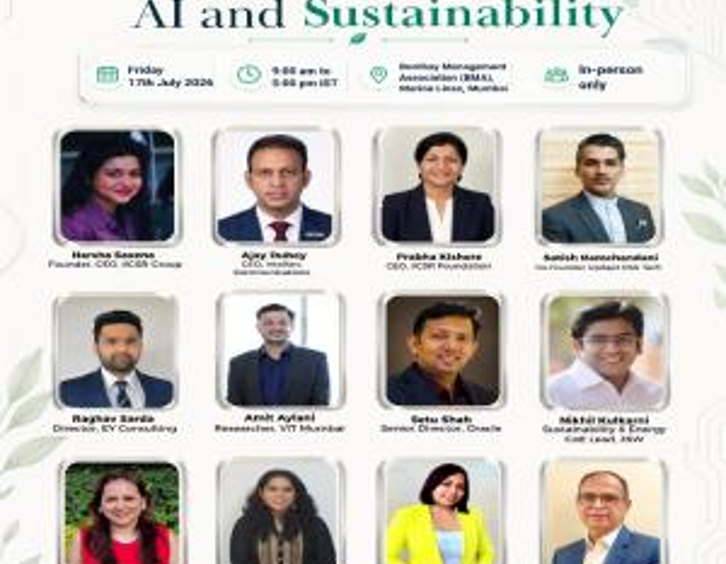
The programme featured 12 speakers and facilitators representing technology, sustainability, consulting, ESG platforms, academia and entrepreneurship.
They included Harsha Saxena, Founder and CEO of IICSR Group; Prabha Kishore, CEO of IICSR Foundation; Ajay Dubey, CEO of Intellerac Communications; Satish Ramchandani, Co Founder of Updapt ESG Tech; Raghav Sarda, Director at EY Consulting; Amit Aylani, Researcher at VIT Mumbai; Setu Shah, Senior Director at Oracle; Nikhil Kulkarni, Sustainability and Energy Centre of Excellence Lead at JSW; Surabhi Kejriwal, Firm Director at Deloitte; Deepshikha Dalchand, Head of ESG at GovEVA; Rashmi Birla, Founder and CEO of Enggauge Solutions; and Jangoo Dalal, Co Founder and CEO of GovEVA.
The diversity of expertise allowed participants to examine AI through multiple lenses, from enterprise strategy and energy management to ESG reporting, governance, communications and organisational transformation.
Turning Ideas Into a 90 Day Roadmap
A notable feature of the programme was its emphasis on implementation. Participants were encouraged to develop a 90 day AI and sustainability roadmap rather than leave with theoretical insights alone.
The framework addressed six priorities: integrating AI into enterprise sustainability strategy, measuring return on investment, monitoring emissions reductions, building cross functional teams, developing a 90 day implementation plan and establishing ongoing governance support.
Participants were encouraged to begin with a clearly defined business or sustainability challenge rather than choosing an AI tool first. The distinction matters. Technology without a measurable objective can create complexity rather than value.
Workshops explored applications including energy demand forecasting, automated Scope 1, Scope 2 and Scope 3 data collection, emissions anomaly detection, high emission supplier identification, climate related supply chain forecasting, logistics optimisation and water efficiency.
A predictive emissions tracking case study demonstrated how AI could support real time carbon monitoring across global supply chains and improve the accuracy of Scope 3 management.
Building Responsible AI Systems
The second workshop introduced a six step methodology covering problem identification, AI model selection, tool selection, data mapping, impact measurement and responsible AI governance.
Prabha Kishore emphasised that technology must remain connected to human outcomes.
“AI must not become another layer of complexity imposed on sustainability programmes. It should help organisations understand communities more accurately, allocate resources efficiently and measure whether interventions are creating lasting change. A system may process millions of data points, but its success must ultimately be judged by whether it improves outcomes for people and the planet,” she said.
That perspective is particularly important as companies increasingly use AI to support sustainability reporting and stakeholder communication.
AI Has a Sustainability Cost Too
The programme did not treat AI as an uncomplicated solution. Data centres require substantial electricity, while cooling infrastructure can consume significant quantities of water. More powerful models therefore bring their own energy, carbon and resource considerations.
Participants also examined model bias, data quality, regulatory alignment, accountability and the risk of AI assisted greenwashing.
An automated sustainability report is not necessarily an accurate one. If underlying data is incomplete or assumptions are unverified, AI can simply transform poor information into polished claims at greater speed.
That makes governance essential. Companies need controls around data sources, model selection, auditability, human verification, disclosure approval and regulatory compliance. Responsibility cannot be delegated to an algorithm.
Four Priorities for Corporate Leaders
The programme concluded with four strategic messages.
AI can become a Net Zero enabler by supporting emissions forecasting, energy optimisation, carbon accounting and climate risk management.
Companies need to move from ESG reporting to ESG intelligence, using predictive information to determine what actions should come next rather than simply documenting what happened.
Governance is critical to preventing greenwashing, ensuring that AI generated sustainability claims remain evidence based, auditable and subject to human accountability.
Finally, responsible early adoption can create competitive advantage. Organisations that invest in reliable data, governance and skills may be better positioned to achieve cost savings, improve risk visibility and strengthen stakeholder trust.
The larger message is clear. AI and sustainability are no longer separate boardroom agendas. They are increasingly converging around investment, risk, operations and long term competitiveness.
The winners of the next phase may not be the companies using the most AI. They may be the ones that know where it matters, how to measure its impact and when human judgement must remain firmly in control.
The programme’s value therefore depends on whether its broad claims can be translated into auditable metrics, accountable owners and evidence of measurable outcomes rather than remaining at the level of strategy and aspiration.