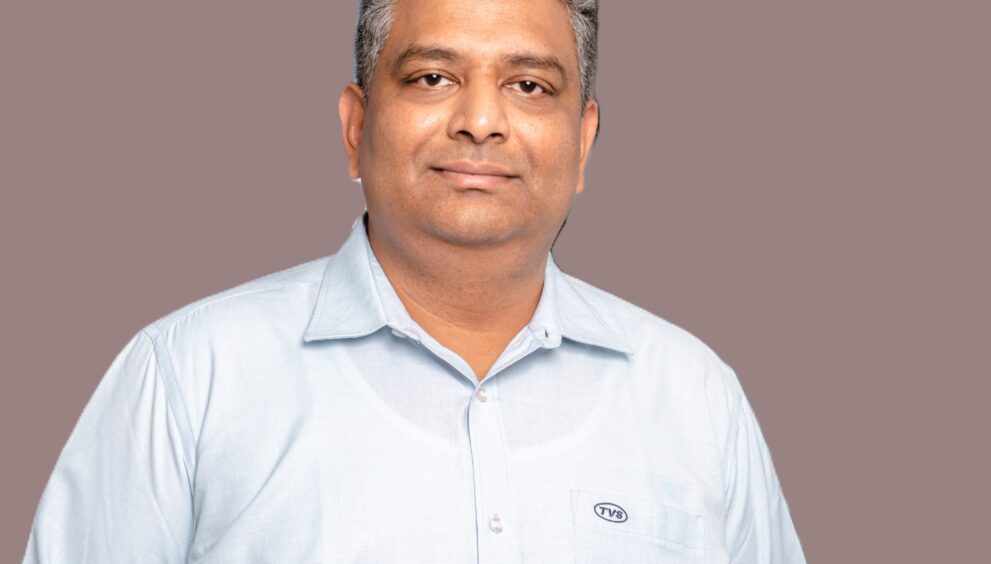
As Indian enterprises accelerate digital transformation, the role of integrated technology partners has never been more critical. TVS Electronics is repositioning itself from a hardware-centric organisation to a holistic technology solutions provider, spanning IT infrastructure, managed services, cloud, and sustainable innovation. In this conversation with WEM India Magazine, the company’s CRO shares insights on enterprise modernisation, sectoral inflexion points, sustainability-led adjacencies, and the leadership philosophy guiding TVSE’s next decade of growth.
1. TVS Electronics has evolved from a hardware-led organisation into a holistic technology solutions provider. From your vantage point as CRO, how do you see this transformation redefining the company’s growth trajectory over the next decade?
The shift from hardware to integrated tech solutions changes the growth curve. Hardware is linear and margin-constrained; solutions and managed services are annuity-led and scalable. This transformation allows us to move from transactional growth to predictable, multi-year revenue streams, deeper client lock-in, and higher lifetime value, particularly across large and mid-size enterprises.
2. With over two decades of experience across global IT giants like Cognizant and HCL, what distinct leadership or execution philosophies have you brought into TVS Electronics, especially in driving FSS and IMS businesses?
The key philosophies that stand out to me are:
Deep customer obsession—truly understanding customers, empathising with their challenges, and consistently creating tangible business value while earning lasting mindshare.
Execution speed—I believe execution speed is a decisive advantage; rather than waiting for perfect plans, we act with clarity, execute early, and iterate based on real outcomes.
Integrity—Above all, integrity is non-negotiable. There is no compromise in how we engage, deliver, or decide—because trust and ethical conduct are the foundation of sustainable, long-term business success.
3. India’s enterprises are at different stages of digital maturity. How does TVS Electronics tailor its IT-Infra Managed Services and lifecycle management offerings to meet the varied needs of mid-sized versus large enterprises?
Digital maturity varies widely.
Mid-sized enterprises prioritise speed, standardisation, and predictable costs. Here, TVSE delivers modular, bundled IMS offerings with faster onboarding.
Large enterprises demand customisation, compliance, and integration at scale. For them, TVSE provides bespoke lifecycle management, SLAs tied to business outcomes, and hybrid deployment models.
The common thread is flexibility without operational overheads. The TVSE Aikya platform is designed to address these needs and is suitable for large and mid-sized enterprises.
4. TVSE operates at the intersection of hardware, software, and managed services. How critical is this integrated model in helping clients optimise the total cost of ownership while staying future-ready?
The integrated model is a clear differentiator, providing end-to-end visibility across the entire asset lifecycle. This integration drives inherent operational efficiencies, which in turn optimise total cost of ownership over multi-year managed services engagements. By combining complex, enterprise-grade solutions with simplified commercial constructs and clear end-to-end ownership, we reduce friction for customers—an approach that is consistently and highly valued.
5. Cloud, digital infrastructure, and workplace services are undergoing rapid change. What are the most significant shifts you are witnessing in enterprise expectations, and how is TVSE positioning itself to stay ahead?
The three shifts are clear:
Reliability at the core – Customers are looking for IT that is reliable and always on. If there is a failure, the expectation is that it is addressed immediately.
Efficiency in everything – Faster, better, and economical IT operations are table stakes for any Managed Services Provider.
Focus on user experience – While this transformation is happening, enterprises want to ensure the user experience and, in turn, productivity are positively impacted.
6. TVS Electronics has a strong footprint across sectors such as banking, retail, logistics, and government. Which sector do you believe is at an inflexion point today, and why?
BFSI, Retail, and Manufacturing are at an inflexion point.
BFSI – Core systems are stable. Digital channels, compliance, and customer experience are driving large-scale modernisation.
Retail – Retail is expanding at scale, and this is driving significant implementations in edge computing from a technology standpoint.
Manufacturing – An integrated IT and OT strategy is driving transformation in both technology and cybersecurity areas for manufacturing.
TVSE Aikya offers industry-specific solutions for these three sectors.
7. Sustainability has become a business imperative rather than a choice. TVSE’s initiatives in solar installations, EV charging infrastructure, and battery swap solutions signal a strategic intent—how do these align with your broader revenue and innovation strategy?
Sustainability is not peripheral—it is commercially strategic. I believe that solar, EV charging, and other green energy solutions will open new adjacencies in enterprise infrastructure.
8. The Tumakuru EMS facility represents a major manufacturing capability for TVSE. How important are indigenous manufacturing and localisation in strengthening India’s electronics and technology ecosystem?
Local manufacturing improves supply chain resilience, cost competitiveness, and speed to market. The Tumakuru facility positions TVSE as both a technology partner and a Make-in-India enabler, contributing meaningfully to India’s electronics ecosystem while serving global quality standards.
9. Having led enterprise-scale transformation programmes globally, what common mistakes do organisations make while modernising IT infrastructure, and how can they avoid them?
Typical pitfalls include:
Treating modernisation as a one-time project, not a journey. There has to be a phased roadmap with clear business KPI tracking and quick course correction as required.
Over-indexing on tools instead of operations and outcomes. Tools should only be treated as enablers. The transformation design should be operations-led and focus on the problem being addressed and the value being created. Tool and technology selection, in my view, should be the last part of the solution.
Underestimating change management. This gets left out in many large programmes. Change management should start right from the service design phase and not be initiated during the service transition phase.
10. You are known for your people-first leadership approach. In a technology-driven business where speed and efficiency are paramount, how do you balance performance with empathy and team empowerment?
High performance and empathy are not opposites. Clarity of goals, transparent metrics, and empowerment create speed. Empathy ensures the sustainability of performance. At scale, people don’t slow execution—misalignment does. This empathy needs to extend to all stakeholders involved—team members, customers, as well as partners.
11. As organisations increasingly prioritise user experience alongside operational resilience, how does TVS Electronics ensure that technology remains human-centric rather than just system-centric?
Technology must enhance how people work, not burden them. TVSE focuses on:
- User experience in workplace services
- Automation that removes friction, not control
- Support models that are proactive, not reactive
The end-user is treated as a stakeholder, not a ticket number.
12. Finally, looking ahead, what does success look like for you—both personally and professionally—at TVS Electronics, and what legacy do you hope to build as a leader in India’s enterprise technology landscape?
Professionally, success means building a durable, high-growth enterprise business with strong margins, technology leadership, and repeatable execution. Personally, it is about leaving behind leaders who think in outcomes, not hierarchies, and an organisation known for trust, execution excellence, and relevance in India’s enterprise technology landscape.