With a new multi-year Sentosa partnership, global music headliners and a significantly expanded wellness programme, Glow Festival by Prudential is positioning itself not merely as an event, but as a larger statement about the future of wellness tourism, experiential leisure and community-driven lifestyle culture in Singapore. Singapore’s wellness economy is getting a louder, more ambitious stage.
Glow Festival by Prudential will return to Sentosa this July with its largest edition to date, widening its footprint from a boutique wellness gathering into a far more expansive lifestyle platform that blends movement, music, hospitality and tourism. Running from 10 to 19 July 2026, with the main festival grounds active from 17 to 19 July at Palawan Green, the event is entering a significant new phase, backed by a three-year partnership involving Sentosa Development Corporation, the Singapore Tourism Board, Prudential Singapore and Exceed Sports & Entertainment, the founder of Glow Festival.
The scale of this year’s edition signals a clear strategic ambition. Glow is no longer presenting itself simply as a wellness festival in the narrow sense of the term. It is increasingly positioning itself as an immersive consumer experience built around the modern wellness economy, one that speaks not only to fitness enthusiasts but also to brands, tourism planners, hospitality players and a broader generation of consumers seeking experiences that blend health, entertainment and social connection in one curated setting.
That evolution feels timely. Wellness is no longer a fringe lifestyle category or a niche urban indulgence. It has become a commercial and cultural force shaping everything from travel and hospitality to retail, food, fitness and preventive health. Around the world, cities and destinations are competing to claim a share of that spending. Singapore, with its appetite for premium experiences and its growing interest in live events, is a natural arena for that push.
Glow’s organisers appear to understand that the future of wellness events lies not in solemn retreat culture, but in accessibility, energy and relevance. This year’s edition promises more than 70 wellness sessions across the festival period, spanning sunrise yoga, seafront runs, strength training, breathwork, recovery experiences and creative workshops. The idea is not to preach wellness as discipline, but to package it as something communal, experiential and socially magnetic.
That ethos was underlined by Martin Capstick, Chief Executive Officer of Exceed Sports & Entertainment and founder of Glow Festival, who described the event as an effort to reimagine how wellness is experienced by making it more inclusive, social and culturally resonant. The new partnership with Prudential, Sentosa Development Corporation and the Singapore Tourism Board, he said, marks a major step in scaling the concept and broadening its appeal through global talent, immersive formats and a more ambitious programme.
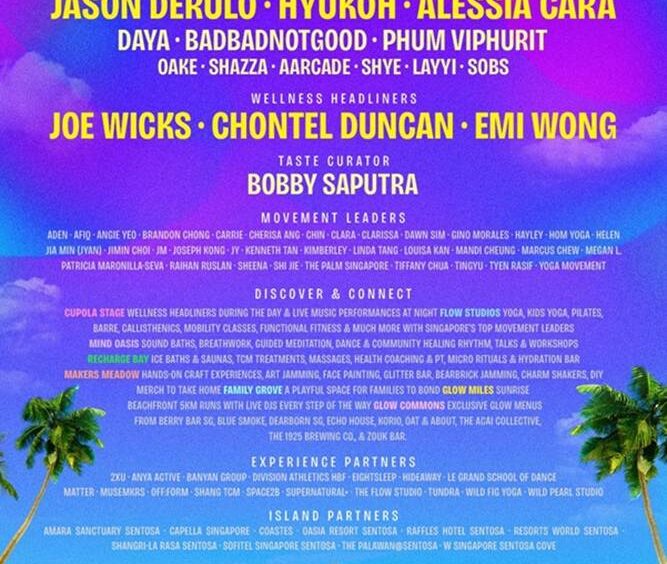
The lineup reflects that intention. By day, Glow will feature a roster of high-profile fitness personalities, including Joe Wicks, widely recognised as The Body Coach, strength coach Chontel Duncan and digital fitness creator Emi Wong, whose online following has helped make her one of Asia’s more recognisable wellness figures. By night, the festival pivots into a more overt entertainment format, with headline performances from Jason Derulo, Korean indie band Hyukoh and Grammy-winning singer-songwriter Alessia Cara. The message is unmistakable: Glow is not asking audiences to choose between a wellness retreat and a music festival. It is trying to collapse the categories altogether.
For Singapore, that hybrid positioning could be commercially meaningful. Lifestyle events that combine music, movement, food and destination appeal are increasingly valuable because they create longer dwell time, wider demographic appeal and stronger partnership opportunities across tourism, hospitality and consumer brands. They also fit neatly into a broader post-pandemic shift in spending, where consumers are placing a premium on memorable, shareable experiences rather than simply transactional leisure.
The festival’s move into a deeper partnership with Sentosa reinforces that point. Sentosa is not merely hosting Glow; it is becoming part of the proposition. Michael Ma, Assistant Chief Executive of the Business and Digital Technology Group at Sentosa Development Corporation, described the island’s beaches and greenery as an ideal setting for immersive wellness and restoration, with the partnership designed to extend the festival beyond a single venue and into a broader island-wide experience.
That island-wide programming is one of the more commercially interesting elements of this year’s edition. While the main festival grounds at Palawan Green will serve as the focal point from 17 to 19 July, Glow will also extend across Sentosa’s hospitality ecosystem from 10 to 19 July, with activations and wellness offerings hosted at a number of high-profile properties, including Raffles Sentosa Singapore, Sofitel Singapore Sentosa Resort & Spa, Amara Sanctuary Resort Sentosa, W Singapore Sentosa Cove and Shangri-La Rasa Sentosa.
In effect, Glow is becoming a distributed destination experience rather than a single-ticket event. That matters because it allows organisers and partners to monetise the festival across accommodation, dining, spa experiences, branded activations and destination programming, while also strengthening Sentosa’s positioning as more than a leisure island. It becomes, at least for ten days, a curated wellness district.
The structure of the festival grounds itself reflects that broader ambition. Palawan Green will be divided into six immersive zones, each designed around a distinct mode of engagement. The Cupola Stage will anchor large-scale movement sessions and headline performances, while Flow Studios will host classes in yoga, Pilates, barre, mobility and functional fitness. Elsewhere, Mind Oasis will focus on meditation and mindfulness, Makers Meadow will lean into creative workshops, Recharge Bay will centre recovery experiences such as ice baths and stretching, and Glow Commons will bring together food and beverage concepts intended to fuel and extend the day’s programming.
Prudential, returning as presenting sponsor for the third consecutive year, is also deepening its role through its Every Body Club ecosystem, which is built around health, community and wellness. The insurer’s experiential presence at the festival will include healthy food offerings, sports accessories and access to physiotherapy and chiropractic consultations for Prudential customers. It is a smart extension of what financial services brands increasingly want from wellness partnerships: not simply logo visibility, but a chance to embed themselves in a broader conversation around long-term health, prevention and quality of life.
Toni Fung, Chief Customer and Marketing Officer at Prudential Singapore, framed the sponsorship in precisely those terms, noting that while health and protection remain central to the company’s proposition, wellbeing is becoming more important and more personal as people live longer lives. That shift, she suggested, is what makes a platform like Glow relevant to Prudential’s wider customer ecosystem.
There is a larger tourism angle here too. Lilian Chee, Director of Sports at the Singapore Tourism Board, linked the festival directly to Singapore’s Tourism 2040 vision, which identifies wellness and quality leisure events as areas of growth. That is a notable framing because it positions Glow not just as a successful local festival, but as a potential tourism asset in its own right, one capable of reinforcing Singapore’s credentials as an urban wellness destination.
That may ultimately be the most important story behind this year’s edition. Glow Festival by Prudential is expanding at a moment when the business of wellness is converging with the business of destination branding. Consumers want movement, recovery, entertainment and connection in one place. Cities want events that bring in visitors, animate hospitality assets and project a more contemporary lifestyle identity. Brands want platforms that allow them to speak to wellbeing in a way that feels lived rather than advertised. Glow sits neatly at the intersection of all three.
It also reflects a wider shift in how wellness is being packaged for a younger, experience-led audience. The old vocabulary of wellness often leaned towards retreat, restraint and personal optimisation. Glow’s vocabulary is more social, more performative and more elastic. It is wellness as festival, as community ritual, as lifestyle marker and as entertainment product.
That makes it worth watching beyond the event calendar. If Glow succeeds in translating this larger vision into sustained attendance, strong partner returns and international attention, it could become one of the more interesting case studies in how wellness events evolve into destination-scale platforms.
Readers following the wider evolution of experience-led business, consumer culture and destination branding can find more features and leadership stories at WEM India. More details on passes, schedules and festival programming are available via Glow Festival by Prudential.