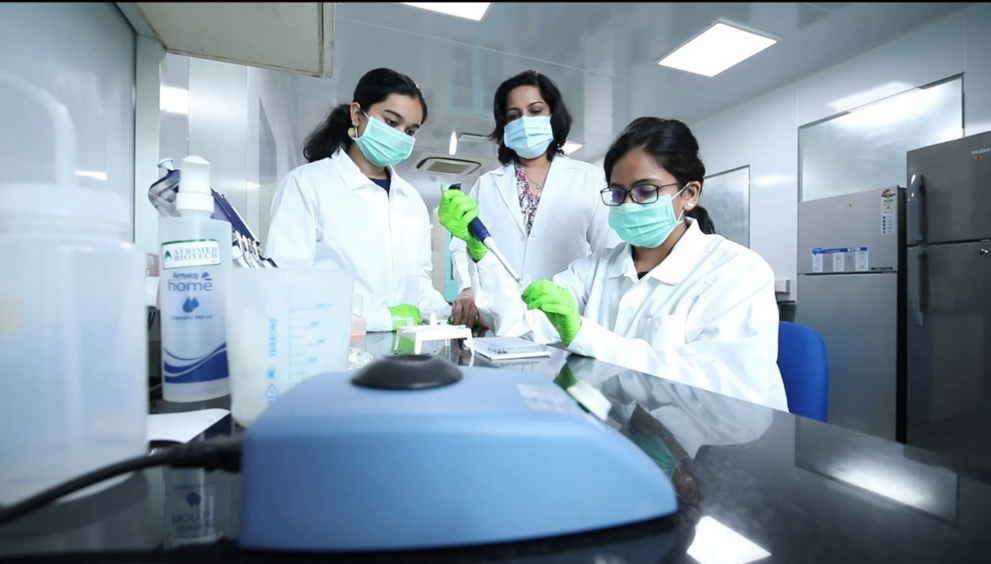
Physician-scientist Dr. Latha Damle helps lead long-term research effort cataloguing nearly 500,000 plant-d
| BANGALORE, INDIA, January 7, 2026 /EINPresswire.com/ — ATRIMED has highlighted the role of female leadership in advanced scientific research as it marks a major milestone in its long-running effort to build what the company believes could be the world’s largest plant molecule library. The library, now approaching 500,000 plant-derived molecules, reflects years of research led in part by physician-scientist Dr. Latha Damle, working alongside her husband and research partner, Dr. Damle. The achievement underscores a broader narrative of women leading high-complexity scientific initiatives in areas often assumed to require massive institutional infrastructure. At ATRIMED, Dr. Latha Damle has been instrumental in shaping a research program that seeks to translate traditional plant-based knowledge into a modern, testable scientific framework grounded in chemistry, data organization, and computational analysis. Plants are known to produce extraordinarily complex molecules as part of their natural defense, signaling, and stress-response systems. Many of these compounds are difficult, if not impossible, to reproduce synthetically, and the chemical diversity of the plant kingdom remains vastly underexplored by conventional pharmaceutical discovery pipelines. ATRIMED’s work aims to address this gap by building a research infrastructure capable of studying plant chemistry at unprecedented scale. The company’s approach begins with systematic organization. Rather than examining plant compounds in isolation, ATRIMED has focused on creating a structured, searchable catalog of plant-derived molecules large enough to support pattern recognition and comparative analysis. By grouping compounds by structural similarity and plant family, researchers can more efficiently identify clusters of molecules that may warrant deeper scientific investigation. ATRIMED reports that its internal library now contains nearly half a million distinct plant-derived molecules, a scale that the company believes may represent the largest such collection globally. According to ATRIMED, this scale is essential to moving beyond anecdotal or fragmented research and toward a more comprehensive understanding of plant chemistry. To make such a large library usable, ATRIMED pairs its molecular catalog with in silico testing, a form of computer-based analysis used to screen and prioritize compounds before more resource-intensive laboratory testing. In silico methods involve modeling biological targets—such as receptors, enzymes, or proteins—and estimating which molecules in a large library may plausibly interact with those targets. ATRIMED emphasizes that this computational screening is not a claim of clinical efficacy or proof in humans. Instead, it serves as an early-stage filtering mechanism. When hundreds of thousands of molecules are involved, in silico analysis can significantly reduce trial-and-error, helping researchers decide which candidates should advance to laboratory validation and, potentially, later stages of development. The company refers to this approach as receptor site modeling and mapping and notes that it began applying computational methods to botanical chemistry in the mid-2000s, as advances in computing power made large-scale analysis more practical. This combination of traditional plant knowledge, chemical cataloguing, and modern computation forms the foundation of ATRIMED’s research strategy. While the current announcement focuses primarily on research infrastructure, ATRIMED notes that this strategy has informed practical outcomes over time. One such example is Sorion, a topical herbal formulation that gained international recognition, including adoption in Germany. The company clarifies that this reference is intended to illustrate the broader research arc rather than serve as a product announcement. Beyond the technical milestone, ATRIMED’s update highlights the often underrecognized role of women scientists in building and sustaining long-term research programs. Dr. Latha Damle’s leadership exemplifies how sustained scientific progress can emerge from focused, methodical work outside traditional large-scale institutional settings. As ATRIMED continues to expand its plant molecule library, the company positions its work at the intersection of traditional botanical knowledge and modern scientific tools, with an emphasis on careful screening, structured data, and early-stage computational evaluation. |
About ATRIMED
ATRIMED is an India-based pharmaceutical company focused on plant-derived molecules, with a strong emphasis on research and development and computational approaches to early-stage therapeutic evaluation. The company applies in silico receptor modeling to help prioritize which plant-based compounds merit deeper investigation before advancing into more resource-intensive testing stages.