At VivaTech Paris 2026, Repos Energy turned a global spotlight on India’s next energy frontier, unveiling its autonomous fuelling solution before Union Minister Piyush Goyal and positioning itself at the intersection of AI, robotics, mobility and energy transition
India’s technology story has often been told through software exports, digital payments and startup scale. But at VivaTech Paris 2026, one Pune-based company offered a glimpse of a different future, one where India is not merely digitising services or building apps for scale, but reimagining physical infrastructure itself.
Repos Energy, the energy-tech startup known for pioneering doorstep fuel delivery in India, showcased a live working prototype of its Autonomous Fuelling Solution at the India Pavilion, marking one of the most striking deep-tech presentations from the country at Europe’s largest technology and innovation summit. The moment carried additional significance because it came as India made its debut as AI Country Partner at VivaTech 2026, with its largest-ever national pavilion and a curated lineup of 25 high-potential startups selected under DPIIT’s Bharat Innovates theme.
Repos was one of them. But its presence was about more than startup representation. It was about putting forward a bold proposition: that the future of fuelling infrastructure may be autonomous, intelligent, digitally connected and built in India.
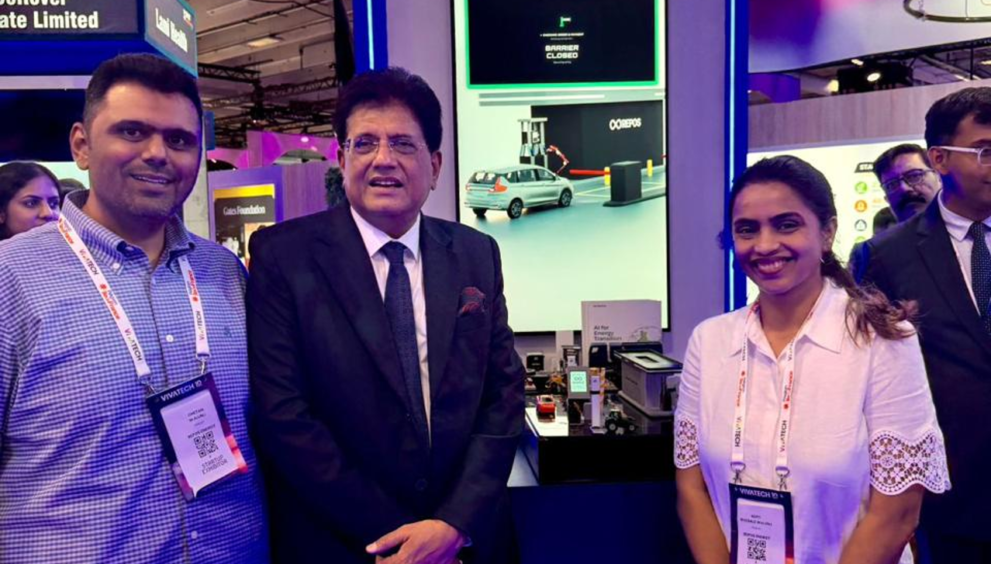
The showcase drew high-level attention, including a visit from Union Minister of Commerce and Industry Shri Piyush Goyal, who attended the summit alongside French President Emmanuel Macron as India pushed its deep-tech credentials on the world stage. At the Repos booth, the conversation went well beyond product demonstration. It centred on how autonomous fuelling could emerge as a serious new frontier for India’s energy ecosystem, supported by both entrepreneurial ambition and government intent.
That is what made the Paris showcase notable. Repos was not unveiling a convenience-led gadget or a niche enterprise tool. It was presenting a vision for what fuel stations and energy access systems could become in the years ahead, powered by artificial intelligence, IoT, robotics and digital payments, and designed to function with minimal human intervention.
Its prototype integrates AI-based demand forecasting, IoT-enabled remote monitoring, robotic dispensing systems and frictionless payment infrastructure, creating a model for a fuelling station that is faster, smarter, more efficient and potentially adaptable to both conventional fuels and future energy formats. In practical terms, the idea is to create infrastructure that reduces operational friction while improving safety, transparency and responsiveness. In strategic terms, it places fuelling infrastructure within the broader global conversation around automation, decarbonisation and intelligent energy systems.
For India, the timing is especially relevant. The country is expanding rapidly across logistics, mobility, industrial infrastructure and digital commerce, while also navigating the long-term challenge of energy transition. In that context, autonomous fuelling is not merely about replacing human-operated pumps with machines. It is about rethinking how energy is delivered, tracked, optimised and integrated into larger systems of transport and commerce.
Speaking at the summit, Shri Piyush Goyal framed the technology in exactly those terms. “India’s vision for energy transition is not just about adoption, it is about building the infrastructure that defines the future. Autonomous Fuelling is a critical piece of that puzzle, and the Government of India, through the Ministry of Commerce and Industry, is committed to creating the right policy environment to introduce and scale this technology across the country. Startups like Repos Energy, who are building at the intersection of AI, IoT, and energy, are exactly the kind of innovators that will help India lead the global energy transition. VivaTech 2026 is a fitting platform to announce this intent to the world.”
For Repos Energy, that endorsement represents more than visibility. It signals alignment between startup innovation and policy direction at a moment when India is trying to define its place in the next generation of industrial and technological infrastructure.
The company’s founders, Aditi Bhosale Walunj and Chetan Walunj, have spent the better part of the past decade building toward this point. Repos began in 2017 with a deceptively simple but highly disruptive idea: what if fuel came to you instead of the other way around? That question led to one of India’s most visible energy-tech ventures, with Repos helping shape the doorstep fuel delivery ecosystem and working with the Government of India on the policy framework that made it viable. Over time, what started as a logistics innovation has evolved into something larger, a company increasingly positioning itself as an AI-driven energy transition infrastructure player. That evolution was on full display in Paris.
“Showcasing our Autonomous Fuelling vision here, on a day when India stands tall on the world stage, is a defining moment, not just for Repos Energy, but for every Indian entrepreneur who dares to build for the world,” said Aditi Bhosale Walunj, Founder, Repos Energy. “When we started in 2017, we never imagined it would bring us here. This is proof that when you build with conviction, the world takes notice.”
Her co-founder Chetan Walunj placed the opportunity in even broader terms. “The future of energy is autonomous, intelligent, and made in India. By combining AI, IoT, and robotics, we are not just reimagining fuel delivery, we are building the infrastructure that will power the world’s energy transition. This is Repos Energy’s commitment to Viksit Bharat, and beyond.”
Those remarks capture the company’s ambition, but they also speak to a larger shift in India’s startup narrative. For years, Indian innovation has been celebrated for scale, speed and digital adoption. What companies like Repos are now attempting is something more infrastructure-heavy and globally consequential: building exportable deep-tech systems that sit at the crossroads of energy, automation and public utility.
Repos already brings substantial operating credibility to that ambition. The company says it has built a network of 2,500-plus fuelling partners and served more than 25,000 businesses across India. It has also drawn notable backing, including support from the late Ratan Tata, who invested in the company across two funding rounds. That combination of operational traction, policy engagement and investor validation gives weight to its latest pivot.
Its presence at VivaTech therefore felt less like a one-off showcase and more like a declaration of intent. Repos is positioning itself at the meeting point of two powerful stories: India’s emergence as a serious deep-tech nation, and the world’s search for smarter, cleaner and more efficient energy infrastructure.
If Paris was the stage, autonomous fuelling was the message. And Repos Energy made it clear that for India’s next energy chapter, the pump of the future may not look anything like the one we know today.